

4th Organization of Islamic Cooperation Youth Scientific Congress held at KFU
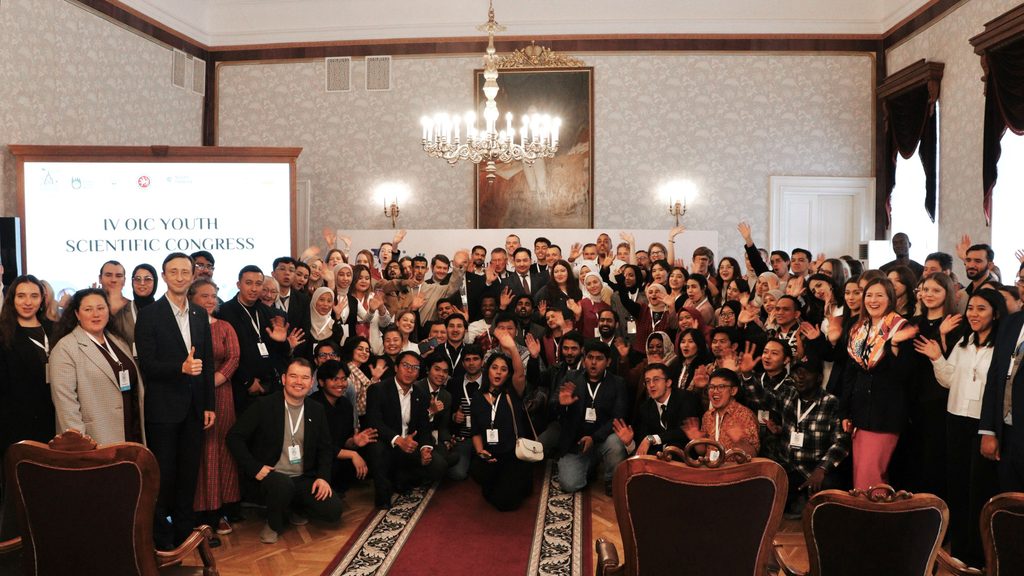
The main topic of discussion during the opening ceremony on September 30 was science in an era of global change and the role of artificial intelligence.
The audience was welcomed by Marat Gatin, Assistant to the Rais (Head) of the Republic of Tatarstan and Deputy Chairman of the Group of Strategic Vision Russia–Islamic World; Timur Suleimanov, Aide to the Rais of Tatarstan and Chairman of the Council of the regional branch of the Movement of the First in Tatarstan; Vladislav Usanov, Deputy Minister for Youth Affairs of Tatarstan; Dr Shahid Mahmood, Chairman of Interactive Group and Senior Honorary Adviser to COMSTECH; and Timirkhan Alishev, Vice-Rector for International Affairs at Kazan Federal University.
“It is gratifying that this forum is being held in Kazan for the fourth time. It should also be noted that Kazan University has not only become the venue for this important event, but is also the initiator of this project,” Mr Gatin stated.
According to him, the congress is gaining momentum year after year, expanding its geographical reach, while the topics proposed for discussion are becoming increasingly interesting and relevant.
“The Group of Strategic Vision Russia–Islamic World itself is intended to serve as a kind of facilitator between our states: strengthening existing ties, expanding them, and assisting in the implementation of global plans,” he explained.
Dr Alishev noted that the forum is becoming increasingly well known among partner universities in many OIC countries.
“The standard is rising, as is the number of applications. There is enormous competition and a rigorous selection process, so virtually all areas are in demand. Naturally, it is very important for us that young people see KFU not only as a place to study, but also as a continuation of their scientific careers,” the Vice-Rector said.
Timirkhan Alishev added that there are examples of participants in the first congress returning as interns or enrolling in doctoral programmes.
Timur Suleimanov drew attention to the challenges faced by the modern world.
“Artificial intelligence brings not only opportunities but also difficulties, sometimes leaving us feeling confused. It is important to understand that we are the ones responsible for correcting this situation,” he said confidently.
Mr Usanov welcomed the participants on behalf of the Ministry for Youth Affairs of the Republic of Tatarstan.
“Thanks to the support of the Rais of the Republic, Rustam Minnikhanov, we have created all the necessary conditions for different categories of young people. Of course, one of our priorities is young researchers,” the Deputy Minister noted.
He mentioned that Tatarstan occupies leading positions in the ranking of scientific and technological development, while in the Russian Federation’s youth policy ranking the republic took first place last year.
Dr. Shahid Mahmood stated that, in his view, the world currently faces two challenges for which AI must be used: food security and climate change.
The congress continued with a panel session entitled Science in an Era of Global Change: The University of the Future and the Transformation of Educational Ecosystems. The experts discussed the role of artificial intelligence in science and education.
“When you work in science and technology, your developments eventually become products that can be used for anything and can serve humanity. Science and technology have no borders,” said the Chairman of Interactive Group.
Kylimbek Narynbekov, an architect at the construction company Icon Development and a researcher at the Razzakov Kyrgyz State Technical University, described AI as a tool that helps save time.
“AI has entered our lives, and we cannot ignore it, but we must use its best aspects,” the specialist said.
Leonid Isaev, Professor at the National Research University Higher School of Economics and Academic Director of the Centre for Public Diplomacy, urged the audience not to overestimate artificial intelligence.
“It is an ordinary part of our lives, like many other innovations that emerged in the past and always shocked the academic community. I see nothing problematic in the fact that AI is used almost everywhere by both students and teachers. Yes, we need to respond to it, but not through bans,” the professor believes.
Nuriddin Iminokhunov, Director of the IT company Global Move and co-founder of the GDG Tashkent IT community, pointed out that humanity now has more data than ever before.
“Recently, there has been a restructuring of RNA prediction. By using AI and three-dimensional modelling, scientists have found ways to edit genes so that children are not born with diseases. Therefore, I believe we are at an excellent point of growth,” the expert said.
Kazbek Dyussembayev, Senior Lecturer at the Gumilyov Eurasian National University, emphasized that artificial intelligence should not replace natural intelligence.
“It should assist in decision-making and in the development of scientific concepts. In addition, AI can help process large datasets, but scientific conclusions must still be drawn by humans,” he concluded.