

All-Russian Youth Conference Preserving Heritage: Language, History, Culture hosted by KFU
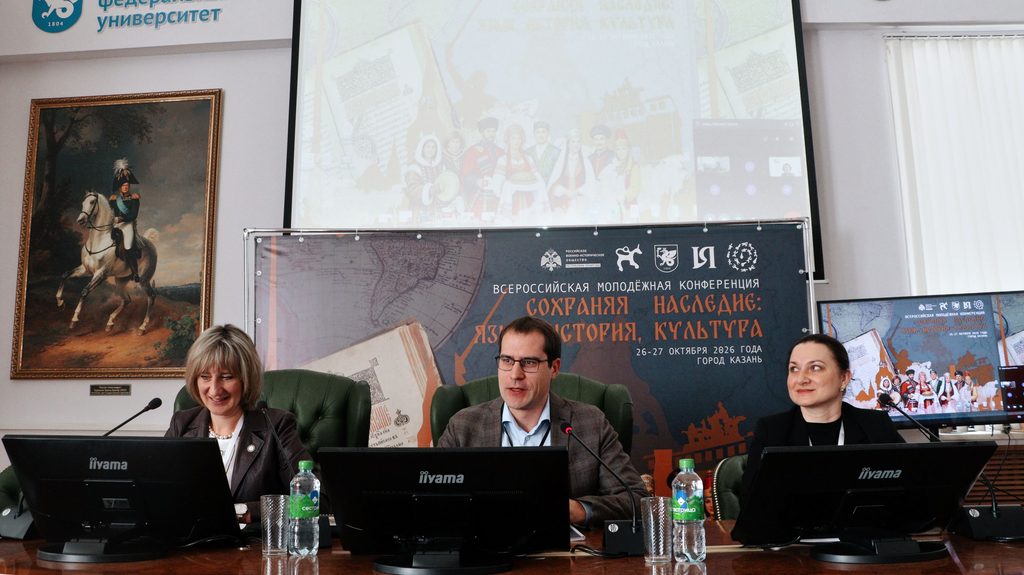
The event is organised by the Tatarstan regional branch of the Russian Military Historical Society in partnership with the Institute of Archaeology, the Institute of Linguistics, and the Institute of Ethnology and Anthropology of the Russian Academy of Sciences, as well as KFU’s Institute of International Relations, History and Eastern Studies. The conference has three thematic tracks: Preserving Heritage: Language, Preserving Heritage: History, and Preserving Heritage: Culture.
Speakers at the opening ceremony included Ilnur Khairullin, Vice-Rector for Continuing Education; Jalil Motygullin, Head of the Science and Technology Policy Department at the Ministry of Education and Science of the Republic of Tatarstan; Timur Kamaletdinov, Executive Director of the Tatarstan regional branch of the Russian Military History Society; Radik Salikhov, Director of the Marjani Institute of History of the Tatarstan Academy of Sciences; and Airat Kayumov, Acting Director of KFU’s Institute of International Relations.
The Head of the Science and Technology Policy Department at Tatarstan’s Ministry of Education and Science noted that the ministry is making substantial efforts to bring young professionals into education and research.
“These people represent a new generation. They have been brought up differently, educated differently, and possess a different set of skills from established leading researchers and specialists. This conference is extremely important for advancing the plans and ideas incorporated into Tatarstan’s programmes for educational, scientific and technological development. Artificial intelligence and emerging trends, such as the creative industries, are widely discussed. What we have continued to regard as innovation turns out to be creative ideas that have already entered widespread use,” Jalil Motygullin said.
Timur Kamaletdinov stressed that the organisation’s primary mission is to preserve the historical memory of the great chapters in the nation’s history.
“This event is specifically intended to engage young people, students and researchers. What matters most is that their enthusiasm for history inspires them to share it with their peers and friends,” he said.
KFU’s Vice-Rector for Continuing Education addressed the participants on behalf of the university’s leadership, observing that the word ‘heritage’ evokes a different image for everyone.
“Heritage does not live in the past; it lives for as long as it is remembered. That is precisely why the conference we are opening today is not about history as such, but about the connection between past and present—a connection that young people hold in their hands,” Ilnur Khairullin emphasised.
Radik Salikhov reminded participants that the current year has been declared the Year of the Unity of the Peoples of Russia nationwide and the Year of Military and Labour Valour in Tatarstan.
“Together, all of this makes up the broader history of our country and our region, which is home to a great many ethnic groups. The scholarly community has a major role to play here — not only established scholars, but also young researchers, including, first and foremost, students at Kazan University. KFU has always upheld the longstanding traditions of our statehood,” he said.
The Acting Director of the Institute of International Relations noted that the conference theme is particularly relevant to the institute and that the university has always maintained the importance of understanding the history of Russia, Tatarstan and the world.
“The Faculty of History at Kazan Federal University has a rich heritage and considerable potential,” Airat Kayumov stressed.
The formal opening ceremony was followed by a plenary session.
“We would like to showcase the opportunities offered by research at the Academy of Sciences and highlight the fields that are currently relevant and developing rapidly. This could provide a springboard for the careers of young professionals, researchers and postgraduate students,” said Tatyana Shvedchikova, a senior research fellow at the Institute of Archaeology of the Russian Academy of Sciences.
Aisa Bitkeeva, Head of the Research Centre for Ethnic and Language Relations at the Institute of Linguistics of the Russian Academy of Sciences, devoted her presentation to ethnicity. She discussed the findings of a study conducted across several regions.
“Our research group carried out a study in the Republic of Tuva, the Republic of Sakha (Yakutia), Kalmykia, Karelia, the Chechen Republic, Dagestan, and Primorsky Krai. We were interested in two questions: what incentives and constraints shape language development in the country? And what is the future of a multilingual, multiethnic country? We found that the combination of factors that help ethnic groups maintain their distinct identities, or, conversely, accelerate their assimilation, varies from one group to another,” the head of the research centre explained.