

Engineering education in the Republic of Tatarstan discussed at the Union State Forum
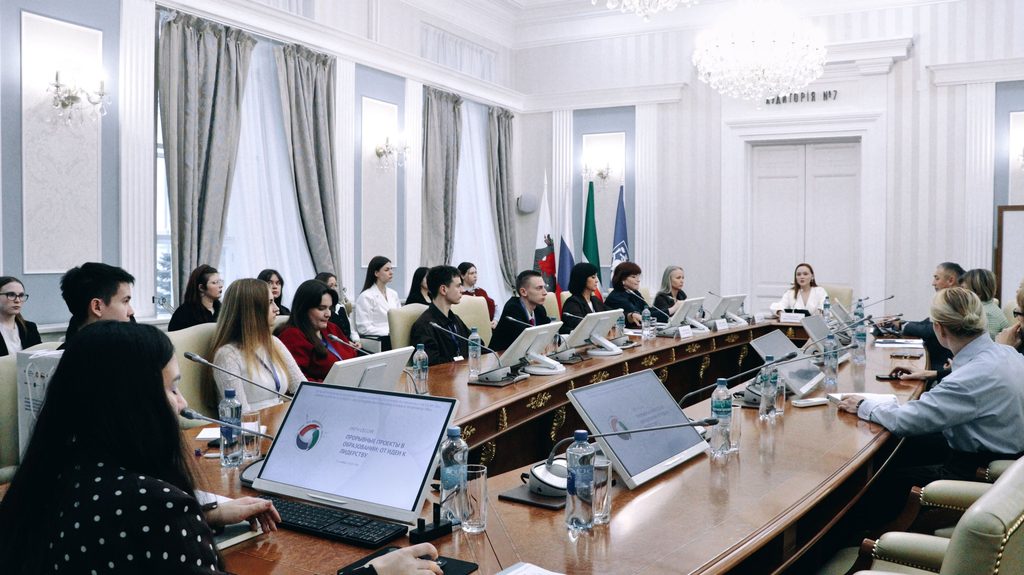
Participants discussed developing the engineering workforce, digital teaching methods, and the role of schools and universities in preparing the next generation of professionals.
A pitch session featuring an extended moderated discussion titled Breakthrough Projects in Education: From Idea to Leadership took place as part of the 15th Forum of Engineering and Technology Universities of the Union State.
Participants included Ramis Muzipov, First Deputy Minister of Education and Science of the Republic of Tatarstan; Ilnur Khairullin, KFU Vice Rector for Continuing Education; Leisan Mingalieva, Director of KFU’s Higher School of Teaching and Professional Excellence; and others. The session was moderated by Aisylu Kamaleeva, Head of the Office for the Development, Approval, and Implementation of Educational Programs within KFU’s Department for the Development of Continuing Education.
Muzipov outlined the current state of engineering education in the region, beginning at the school level.
“Today, we are tasked with building, developing, and replenishing the engineering workforce. The first point I would like to address is the broader shift in the government’s approach to engineering education. There was a time when greater attention was paid to fields such as law, sociology, economics, and accounting. This is reflected in how enrollment quotas were set for vocational and higher education programs,” he explained.
The First Deputy Minister of Education and Science of Tatarstan noted that the situation is changing.
“Exam content specifications are being established to align the tasks on the Unified State Exam and the Basic State Exam with the topics and modules taught in schools. Most importantly, President Vladimir Putin has issued instructions calling for the development of natural science education,” Muzipov emphasized.
He shared figures for the republic.
“Last year, 22 percent of all classes offering specialized study tracks followed a general track; this year, that figure is 16 percent—a decline of several percentage points. At the same time, we are seeing an increase of nearly 5 percent in the technology track. We are trying to keep the socioeconomic and humanities tracks at roughly the same levels,” he explained.
Mingalieva delivered a presentation titled New Directions in Research-Based Teaching Support: Preparing Educators for Digital Teaching and Learning (AI and Media) in Engineering and Technology Education.
“The rise of AI is an irreversible process that involves all of us. Until recently, we were talking about functional literacy; now we are talking about technological literacy and engineering thinking,” she said.
She elaborated on these concepts.
“Technological literacy is the ability to understand, apply, evaluate, and create technological solutions while recognizing their social and ethical implications. Engineering thinking means systematically designing solutions under conditions of uncertainty — from defining the problem through prototyping to testing and optimization,” Mingalieva explained.
She emphasized that workforce preparation begins not at a university but in school, and that schools and universities share responsibility for it.
Natalya Makedonskaya, Deputy Head of the Executive Committee and Head of the Buinsk Municipal District Education Department, and Aliya Bikchantaeva, Deputy Head for Academic and Instructional Affairs and Head of the Information and Methodology Office, presented “Buinsk’s Engineering Future.”
“We follow all the recommendations of Tatarstan’s Ministry of Education and Science. We have classes offering specialized study tracks, and we were allocated additional places in AI clubs, all of which we filled. We approached engineering education through play. At Kazan Digital Week in 2025, students from our Extracurricular Activities Center were the overall winners of the robot battle competition,” Makedonskaya emphasized.