

Future of digital core studies discussed at Kazan Digital Week 2026
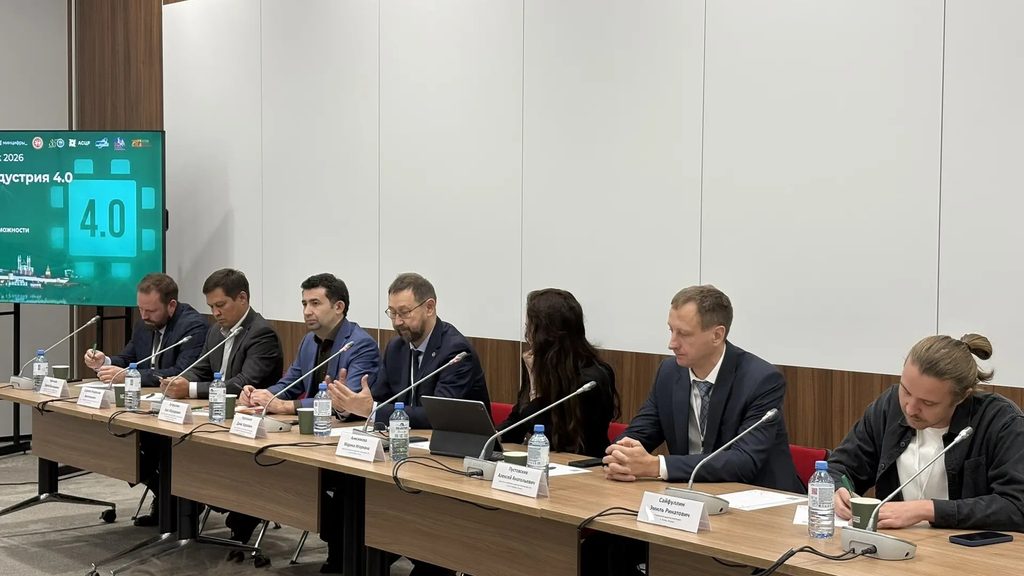
A roundtable titled Digital Core: New Opportunities, organized by the Institute of Geology and Petroleum Technologies (IGPT), took place as part of the Kazan Digital Week forum.
Participants included representatives of IGPT, Innopolis University, Tatneft, the Gazprom Neft Science and Technology Centre, NOVATEK Scientific and Technical Centre, LUKOIL-Engineering, and other organizations. The discussion was moderated by Marina Anisimova, Deputy Director General of the Gazprom Neft Science and Technology Centre.
The meeting focused on the practical application of digital core technology, identified key scientific and technological barriers, and laid the groundwork for a joint industry roadmap for the technology’s development in 2027-2030.
Opening the roundtable, the moderator emphasized the importance of moving from research to industrial deployment of digital core technology. Particular attention was paid to collaboration: the cooperation agreement is intended to provide a foundation for coordinating research and developing a common strategy.
The speakers presented their perspectives: Danis Nurgaliev, Director of the Institute of Geology and Petroleum Technologies; Alexey Pustovskikh, Deputy Director General of the Gazprom Neft Science and Technology Centre; Azat Lutfullin, Deputy Head of the Field Development Department at Tatneft; Sergey Chainikov, Deputy Director for Research at Innopolis University’s Centre for Oil and Gas Technologies; Vladislav Sudakov, Deputy Director for Marketing at the Gazprom Neft–KFU Research and Education Centre; and Emil Saifullin, Technical Director of ChemProphet.
The experts discussed the operational challenges they intend to address using digital core technology, how they envision its development over the next two to three years, and the factors hindering its adoption.
Participants identified priority areas for applying the technology. Key objectives include obtaining quantitative digital data on rock structure and properties, determining porosity, permeability, and other petrophysical characteristics, and using the results in geological modelling, reserves estimation, and state expert review. Other topics included investigating multiphase flow, assessing the effectiveness of enhanced oil recovery methods, accelerating studies, and reducing costs.
An equally important part of the discussion concerned barriers to implementation. Participants focused on the reliability of digital calculations and their comparability with laboratory data, the limited reproducibility of certain stages—particularly image segmentation—and the challenges of working across scales and modelling complex reservoirs. They also highlighted the lack of common terminology, data standards, and research methods; the need to integrate individual algorithms into a unified computational workflow; and regulatory restrictions on the use of the results.
During the roundtable, participants agreed on the main areas of the roadmap and outlined the next steps. A scientific and technical workshop is planned at KFU to develop the work programme in detail.
According to Danis Nurgaliev, Kazan Digital Week is an important platform for interaction between science and industry. The Director of the Institute of Geology and Petroleum Technologies noted that an agreement had been signed at the forum the previous day between universities and leading oil and gas companies: KFU, Innopolis University, Novosibirsk National Research State University, the Gazprom Neft Science and Technology Centre, LUKOIL-Engineering, and NOVATEK Scientific and Technical Centre. Its aim is to establish a long-term strategic partnership and pool scientific, technological, intellectual, and industrial capabilities.
“Today’s roundtable addressed specific issues relating to our cooperation,” Nurgaliev said. “We identified a number of challenges associated with digital core technology. First, there are limitations in the resolution of modern tomography scanners: small channels may not be captured in the model, which distorts permeability calculations. Second, there are fundamental scaling challenges: it is difficult to transfer properties accurately from one scale to another — from pores in core samples at the nanoscale to entire fields spanning kilometres. Most importantly, we agreed to create a shared digital core database that will enable us to train neural networks and other artificial intelligence models effectively to address two major challenges: segmentation and the prediction of rock properties that cannot be investigated using modern rock tomography equipment. I believe that we will obtain interesting results within the next few months and move on to the second stage, which we plan to discuss at next year’s forum.”