

ICESCO Rectors’ Forum held as part of 5th Kazan Global Youth Summit
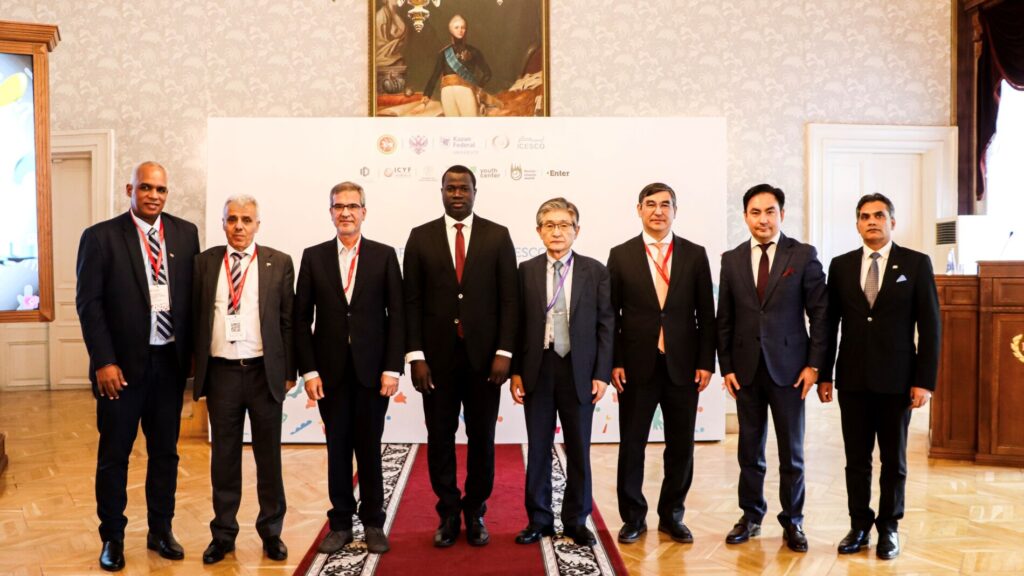
The plenary session was moderated by Kuanysh Yergaliev, Head of the ICESCO Department of Science and Environment. ISESCO Director General Salim Al-Malik addressed the participants with a video message, emphasizing the unique nature of the summit. He also noted that this year Kazan holds the honorary title of Cultural Capital of the Islamic World, which, he said, is a recognition of its rich heritage.
Also participating in the discussion were Amjad Dababat, Minister of Education and Higher Education of the State of Palestine; Bakary Yasser Badji, Minister of Youth and Sports of the Republic of Gambia; Modesto Ricardo Gómez Crespo, First Deputy Minister of Higher Education of the Republic of Cuba; Abolfazl Vahedi, Deputy Minister of Science, Research, and Technology of the Islamic Republic of Iran; Rae Kwon Chung, Nobel Peace Prize Laureate, Chairman of the Global Energy Prize International Award Committee, and Director of the Ban Ki-Moon Foundation (South Korea); and Timirkhan Alishev, Vice-Rector for International Affairs at Kazan Federal University.
Opening the series of speeches, Timirkhan Alishev welcomed the audience on behalf of KFU Rector Lenar Safin and Deputy Minister of Science and Higher Education of the Russian Federation Konstantin Mogilevsky. He emphasized the symbolism of the meeting being held in the Emperor Ballroom, the historical heart of the university, founded in 1804 by decree of Emperor Alexander I.
Kazan Federal University has approximately 13,000 international students from 100 countries, a significant number of whom are citizens of Islamic countries. The Vice Rector listed the key areas in which KFU conducts training and research.
Dr Alishev also noted that Tatarstan is one of Russia’s pilot regions in the development of Islamic finance, a field actively developing at the university.
In his speech, Rae Kwon Chung proposed rethinking the role of educational institutions in the age of digitization.
«One of humanity’s most important values is nature, the ability to share and care for others. Therefore, the university should play a completely different role—not a commercial one, but a role in promoting team building, collaboration, creative collaboration, learning from each other, and the advancement of traditional values,» he proposed.
Mr. Rae Kwon Chung also shared his personal impressions of the city, admitting that this was his first visit to Kazan.
«I am very impressed with Kazan. It’s a city with a rich culture and history. I hope that future generations will take a responsible approach to the environment and ecology,» the Nobel Peace Prize laureate said.
Amjad Dababat used a metaphor, comparing universities to a flame that should shine for students.
«Universities must be a beacon of light for all students, so they can enjoy the light of knowledge, advance their research, and build partnerships,» emphasized the Minister of Education and Higher Education of the State of Palestine.
In his speech, Bakari Yah Badji emphasized the importance of education as a factor in resilience.
«Education is a factor that helps us build resilience, acquire knowledge, competencies, and skills that enable us not to remain static, but to adapt to the challenges of today and those of tomorrow,» stated the Minister of Youth and Sports of the Republic of Gambia.
He emphasized that in the era of globalization, international programs are particularly important for cultural understanding and cooperation among young people.
Modesto Ricardo Gómez Crespo began his speech by thanking the organizers.
«On behalf of the people and government of the Republic of Cuba, I thank the organizers of this significant event in the Russian Federation for their hospitality in welcoming our presence. Speaking of youth means remembering the hope that energizes our desire for life. After all, young people represent the present that builds society and the future that ensures the continuity of our nations,» he noted.
According to the First Deputy Minister of Higher Education of the Republic of Cuba, the meeting is particularly significant because 2026 marks the centenary of Fidel Castro’s birth.
«He taught us faith and love for youth because he understood that all strength lies in their hearts. National policy places young people at the center of social programs, guaranteeing access to education, healthcare, scientific research, employment, culture, and other areas,» he said.
Abolfazl Vahedi concluded the session, defining the future of education as a space where technology does not replace humans, because it is the human mind that is involved in the creation of experiments and technologies.
«The integration of artificial intelligence and technology into education marks the beginning of a transformation through which the educational system can meet the demands of teachers and students,» he said.
Following the plenary session, the forum continued with thematic sections. The second session, The Voice of Youth, was held, focusing on Education in the Era of Global Change: Human Capital for Sustainable Development. The third session, devoted to university networks and strategic partnerships, discussed the role of university associations and global partnerships in the development of higher education in the Islamic world. The business program concluded with a roundtable discussion on Universities of the Future: From Leadership to Innovation.