

KFU’s vision of driverless future presented at Kazan Digital Week
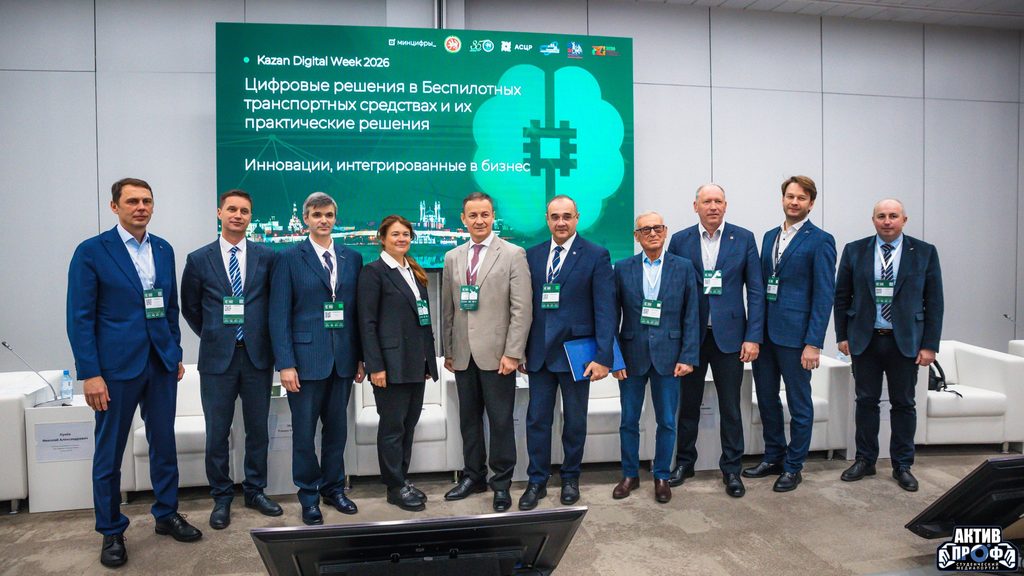
As part of the Innovations Integrated into Business thematic track, Director of the Naberezhnye Chelny Institute Andrey Keller delivered a presentation entitled Practical Solutions for Autonomous Vehicles: The Role and Place of University Research and Education at the session Digital Solutions for Autonomous Vehicles and Their Practical Applications. In his presentation, the institute’s director provided a clear and accessible overview of the university’s key developments. He explained how smart vehicles, whose functions are determined primarily by software, are developed, and how intelligent systems help drivers prevent accidents and monitor blind spots. He also presented the KAMAZ Mayak-2 highly automated truck projects, discussed fuzzy logic-based adaptive control technologies that ensure a smooth ride and the stability of heavy-duty trucks, and described an integrated system for managing autonomous logistics on the M-11 Neva federal highway.
Particular attention was paid to the role of universities in research.
“Universities should not merely supply qualified professionals. Their role is much broader. They serve as centres for development, testing, and simulation, as well as independent platforms for scientific expertise, where theoretical developments are tested in practice,” the director of the Naberezhnye Chelny Institute noted.
Continuing the discussion of workforce development, the presentation addressed the end-to-end integration of education and industry — from a trilateral agreement with KAMAZ and Quantorium to industry-based doctoral training and professional development programmes for practising engineers.
“The guiding principle across all educational pathways is that learning is embedded in a project. Students start with a problem, acquire knowledge as needed, and apply what they have learned to that problem. This approach prepares professionals who can independently develop a solution into a working prototype,” he concluded.
The second major aspect of Keller’s participation in the forum was his role as moderator of the scientific expert session Intelligent Mobility Systems: Theory and Development Prospects. Opening the discussion, he noted that the modern transport sector is undergoing profound systemic changes. The introduction of artificial intelligence and digital technologies is changing not only the technical design of vehicles but also the very principles underpinning the organization of mobility, requiring an interdisciplinary approach and close attention to cybersecurity.
“Today, we view vehicles, road infrastructure, and logistics systems not as separate elements, but as interconnected components of a single intelligent ecosystem focused on safety, efficiency, environmental sustainability, and user convenience,” the moderator emphasized.
Summing up the discussions, forum participants highlighted the considerable scientific and practical potential of intelligent mobility systems. The industry’s future is taking shape at the intersection of science, education, industry, and government regulation, while platforms such as this forum provide a foundation for new collaborative projects and practical initiatives.