

KFU’s work in geology and petroleum science represented at the Forum of the Association of Technical Universities of Russia and China
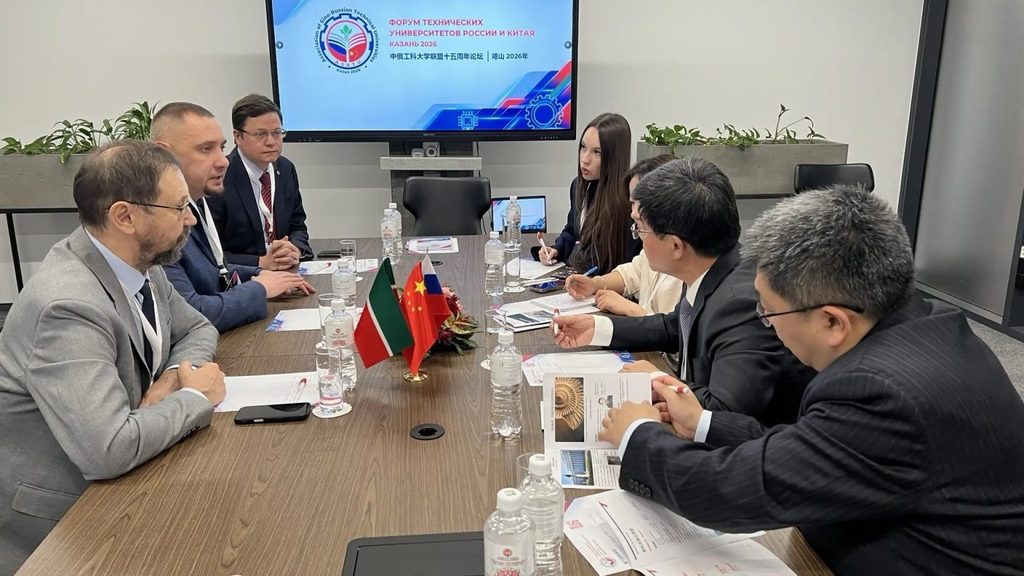
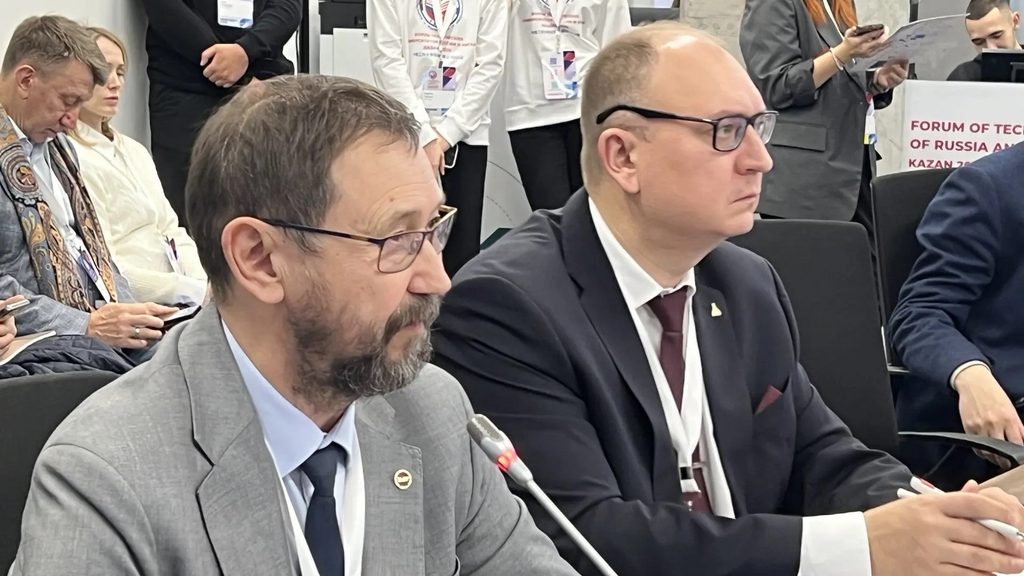
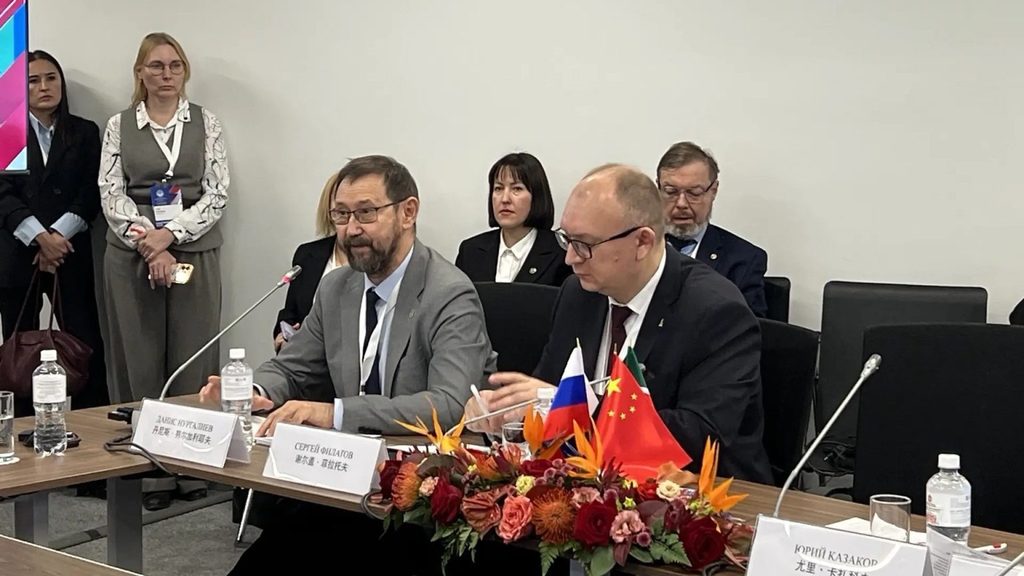
Developments by scientists at the Institute of Geology and Petroleum Technologies (IGPT) of Kazan Federal University were presented at the session “New Technologies in Oil Production and Petrochemistry,” held as part of the forum of technical universities of Russia and China.
The session, which consisted of two sub-sessions, one on oil production and the other on petrochemistry, was moderated by Sergey Filatov, rector of the Mendeleev University of Chemical Technology of Russia (MUCTR).
Before the session began, which was organized by KFU, MUCTR, Kazan National Research Technological University (KNRTU), and East China University of Petroleum, Filatov noted that the China-Russia University of Advanced Technologies (CRUTech) was officially launched in Kazan that day. The joint project of the Republic of Tatarstan and Shandong Province will create a new model of education. Russian and Chinese universities will jointly carry out educational and research activities, with KFU and Shandong University serving as the consortium’s leaders.
Yury Kazakov, rector of Kazan National Research Technological University, reminded participants that 2026–2027 have been declared the cross Years of Russian-Chinese cooperation in education.
“This gives all of us hope and confidence in systematic, long-term cooperation between our universities in both education and scientific research,” he said.
Opening the session, Filatov said that the future of the world’s energy sector is inseparable from developing hard-to-recover hydrocarbon reserves, including ultra-viscous oil, natural bitumen, and tight reservoirs, whose development requires a fundamentally new scientific approach.
“Scientists at one of Russia’s oldest universities have managed to combine catalytic underground oil upgrading, smart chemistry, and artificial intelligence algorithms into a single technological scheme,” he said, introducing a development for which IGPT scientists and employees of Tatneft received a Russian Government Prize in Science and Technology in 2025.
Danis Nurgaliev, director of IGPT, spoke about this and other achievements in his presentation, “Efficient Technologies for Developing Hard-to-Recover Hydrocarbon Reserves: Viscous and Ultra-Viscous Oils and Oil in Tight Reservoirs.”
He opened by introducing Kazan University, which recently marked its 222nd anniversary, and then focused on the institute’s activities, noting that it is carrying out a large number of international projects.
“More than 1,000 representatives of oil and gas companies from Russia and abroad are improving their qualifications at the institute’s Center for Continuing Education, where we teach them about the latest technologies,” he said, among other things.
Nurgaliev outlined the institute’s main research areas. He noted that research on finding and producing hard-to-recover oil is conducted using modern equipment, advanced methods, and artificial intelligence.
Other speakers at the session included Anatoly Nikolaev, rector of Northeastern Federal University; Anton Petrochenkov, rector of Perm National Research Polytechnic University; Zhang Lianzhen, deputy dean and professor in the Department of Storage and Transportation System Design at China University of Petroleum; and Liu Huajie, associate professor at China University of Petroleum’s Research Institute of Intelligent Oil Production.
“Partners of Kazan University in oil and gas from Chinese universities have come to the forum: Southwest Petroleum University, with which we have cooperated for about ten years, and China University of Petroleum, with which we have active educational cooperation. A master’s program in geology has been opened, and one in oil and gas is planned. We will also carry out scientific and technological projects with this university,” said Mikhail Varfolomeev, director of KFU’s Small-Scale Chemical Technology Park.
He added that the forum is a good platform for discussing next steps with Chinese partners.
“Before the session began, IGPT representatives met with Chengdu University of Technology. The Chinese university was represented by Vice President Hou Mingcai and Dong Yi, deputy head of the Department of International Exchanges and Cooperation,” Nurgaliev said. “They expressed strong interest in cooperating on oil and gas technology development. Mikhail Varfolomeev and I, in turn, proposed educational cooperation to the Chinese side and presented IGPT’s master’s programs. Tomorrow, two delegations, from Chengdu University of Technology and Shandong Institute of Petroleum and Chemical Technology, plan to visit the institute. They want to see KFU’s infrastructure and discuss prospects for cooperation.”