

VII Kazan International Linguistic Summit opens at Kazan Federal University
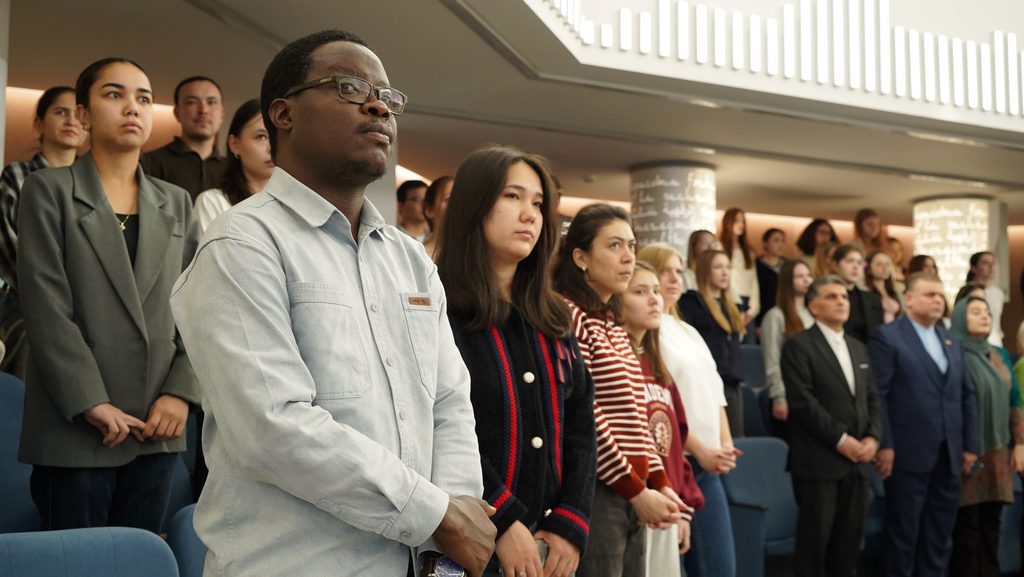
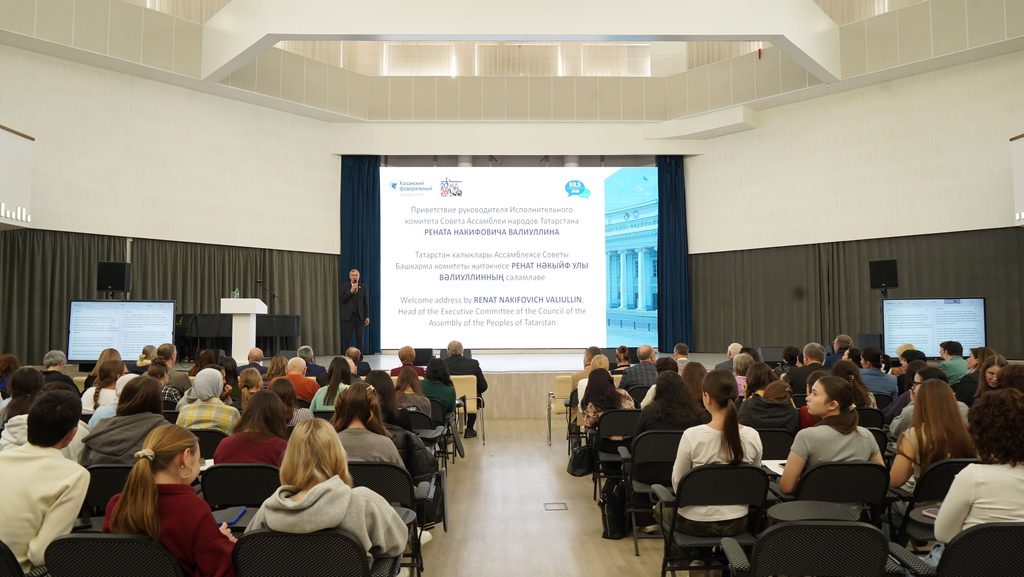
Today, October 28, the VII Kazan International Linguistic Summit (KILS-2026) opened at the Institute of Philology and Intercultural Communication. The forum marks the 150th anniversary of teacher education in the Republic of Tatarstan. The organizers have prepared an extensive program featuring plenary presentations, thematic sessions, talks by academic journal editors, and cultural events. Participants will discuss the challenges of digitalization, artificial intelligence, the preservation of linguistic diversity, and the development of teacher education.
The event is co-organized by the Institute of Linguistics and the Institute for Linguistic Studies of the Russian Academy of Sciences, as well as the Russian Academy of Education. Its partners include the Ministry of Education and Science of the Republic of Tatarstan; the Academy of Sciences of the Republic of Tatarstan; the Institute for Strategy of Education Development; the Federal Institute of the Native Languages of the Peoples of the Russian Federation; the Russian Society of Teachers of Russian Language and Literature; the International Association of Teachers of Russian Language and Literature; the Association of Teachers of Russian Language and Literature; the National Association of Teachers of English; the Association of Teachers of the Native Tatar Language and Literature; the Commission on the Russian Language under the Rais (Head) of the Republic of Tatarstan; and the Commission under the Rais of the Republic of Tatarstan for the Preservation and Development of the Tatar Language and the Native Languages of the Peoples of the Republic.
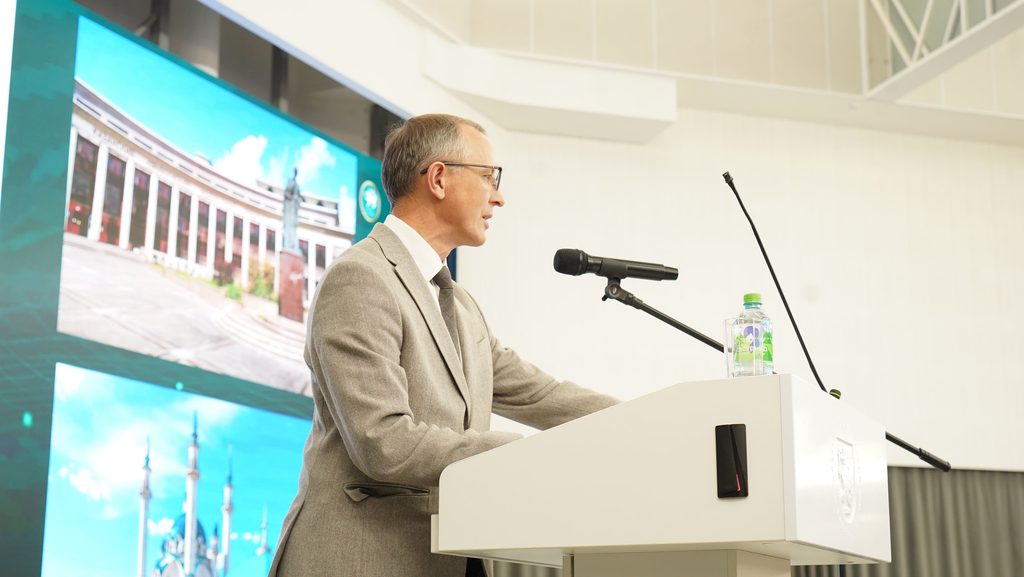
The meeting was opened by Dmitry Tayursky, First Vice-Rector and Vice-Rector for Research. He said that linguistics is currently undergoing ‘tectonic shifts,’ driven in part by the introduction of artificial intelligence.
“It is important to understand that, despite all the investment, AI still cannot come up with a new rhyme the way Pushkin did. It cannot write long sentences that remain structurally stable. There is even a concept known as ‘controlled complexity’ that applies to the texts written by Leo Tolstoy. There were many fears that artificial intelligence would ‘kill off’ minority languages. Instead, it has turned out to support their development. What is particularly interesting, however, is that Chinese, for example, works very well with large language models. Its lexical structure lends itself well to all these methods. The same characters are used in Japanese, but tokenization does not work for that language, and the problem of accounting for the levels of politeness found in Japanese still has not been solved,” Tayursky remarked.
According to the vice-rector, it is important to understand that language remains the only means of transmitting inherited information from one generation to the next.
Irina Terentieva, Chair of the Committee on Education, Culture, Science, and Ethnic Affairs of the State Council of the Republic of Tatarstan, a professor at the Institute of International Relations, History, and Eastern Studies, and Chairwoman of the Women’s League at Kazan Federal University, emphasized that our introduction to linguistics begins long before school.
“Many people think that we first encounter linguistics at school, but that is not the case. In the first years of life, each of us develops the foundations of linguistic ability. We learn to pronounce sounds, try to put words together, and discover their meanings. As we grow a little older, we acquire more complex turns of phrase that allow us to convey precisely what we want to say. Nothing brings people closer together than mutual understanding, and linguistics helps people express their thoughts clearly in everyday conversation, business discussions, and on social media. Language also carries a national culture and shapes a particular way of thinking. Without even noticing it, we encounter this field of knowledge every day and add to what we know,” Terentyeva said.
She stressed that Tatarstan recognizes the importance of supporting both the languages of the peoples living in the Republic and linguistic scholarship.
“This is supported by the development of government and interdepartmental programs, language-support programs, and numerous initiatives in this field. Kazan University, of course, makes the greatest contribution to implementing these programs. For roughly a decade, university staff have successfully carried out a number of regional research and educational projects: publishing the international academic journal Tatarica; organizing courses in Tatar as a native, non-native, and foreign language for residents of the Republic of Tatarstan; holding annual student competitions in Russian and Tatar; and organizing academic conferences devoted to Leo Tolstoy, Gavriil Derzhavin, Vasily Bogoroditsky, and others,” she added.
Ilsur Khadiullin, Minister of Education and Science of the Republic of Tatarstan, welcomed participants on behalf of the ministry and highlighted Kazan Federal University’s contribution to teacher education.
“KFU trains highly qualified specialists who work not only in Tatarstan but also in other regions of our great country and abroad. The Ministry of Education and Science of the Republic of Tatarstan coordinates the program for the preservation and development of languages. We have developed and approved the ‘Russian Language in Tatarstan’ policy framework, along with an action plan for its implementation. Two commissions operate under the Rais of Tatarstan: one on the Russian language and literature, chaired by the Prime Minister, Alexey Pesoshin, and another on the preservation of the cultures, languages, and traditions of the peoples of Tatarstan. The second is chaired by Marat Akhmetov, Deputy Chair of the State Council of the Republic of Tatarstan,” he said.
Vladimir Tolstoy, President of the International Association of Teachers of Russian Language and Literature and the Russian Society of Teachers of Russian Language and Literature, spoke next.
“I always say that important changes occur in a person’s life every seven years. Think about it: at seven, we start school; at fourteen, we enter adolescence; and at twenty-one, a person is generally already studying at university. Today, we are holding the seventh summit, opening a new seven-year period in an important cycle,” Tolstoy explained.
Ainur Timerkhanov, Vice-President of the Academy of Sciences of the Republic of Tatarstan, recalled the traditions of the Kazan School of Linguistics, founded in the nineteenth century by Jan Baudouin de Courtenay.
“The Kazan School of Linguistics established strong traditions of studying the social nature of language, the equality of languages and cultures, and the democratization of the subject matter of research. These ideas continue to live on and develop in the work of Kazan University scholars. It is important to us that the Kazan School of Linguistics continues to exert a significant influence on the development of Tatar philology, helping to enrich and preserve the cultural heritage of the Tatar people,” Timerkhanov said.
He noted that fundamental and applied research in the social sciences and humanities has always been, and remains, central to the work of the Academy of Sciences of the Republic of Tatarstan.
“In a multiethnic region, language issues are not a peripheral academic concern but a prerequisite for social stability. In recent years, our scholars have prepared and published multivolume works on Tatar lexicology, the history of the Tatar literary language, dialectology, and terminology. The six-volume explanatory dictionary of the Tatar language received the State Prize of the Republic of Tatarstan in Science and Technology. A new generation of Tatar language reference dictionaries has been published, including pronunciation and spelling dictionaries, among others. Bilingual dictionaries of specialized terminology are being improved. Many of these major projects are carried out jointly with KFU,” he emphasized.
Renat Valiullin, Head of the Executive Committee of the Council of the Assembly of the Peoples of Tatarstan, stressed that Tatarstan is a multiethnic republic and a home to 175 ethnicities.
“We have a Sunday school. It currently offers instruction in 28 languages across 111 branches, and in the previous academic year we had 1,907 students,” he reported.
Following the opening ceremony and welcoming addresses to participants and guests, the plenary presentations began.
Iskander Yarmakeev, Deputy Director for Research at the Institute of Philology and Intercultural Communication, delivered a presentation entitled “150 Years of Higher Teacher Education at Kazan University.” He recalled that the Kazan Teachers’ Institute and the institutions subsequently established on its foundation had served as a major training ground for teachers in Russian schools and as an important academic and cultural center for the entire Volga region.
“The history of teacher education in Kazan is a chronicle of the dedicated work of scholars and teachers and a continual search for new, high-quality teaching methods and formats that have transformed schools and society as a whole. At different points in history, the institution successfully adapted to the challenges of its time: from the practical training of teachers for urban and rural schools to advanced educational research; from occasional reforms to revolutionary ones; and from incremental changes to the large-scale transformations of the Soviet and post-Soviet eras,” he noted.
The speaker added that teachers’ institutes were established in six educational districts of Russia during the reign of Emperor Alexander II.
“The first institutes opened in St. Petersburg and Moscow, followed a few years later by Kazan, which became the center of an entire educational district encompassing the Vyatka, Kazan, Simbirsk, Samara, and Astrakhan governorates. These teachers’ institutes are the predecessors of Russia’s leading institutions of higher teacher education: Moscow Pedagogical State University, Herzen State Pedagogical University, and Kazan Federal University,” Yarmakeev pointed out.
According to him, there were approximately 4.5 applicants per vacancy at the Kazan Teachers’ Institute when it was first established.
“That was quite a high figure for the time. The institute taught almost all the subjects offered in pre-revolutionary secondary schools, and its graduates were entitled to teach any of the ten subjects included in the curriculum of an urban school: Russian, mathematics, physics, history, geography, and so on,” the researcher added.