

Nobel laureate Chung Rae-kwon gives career advice to future leaders during the 5th Kazan Global Youth Summit
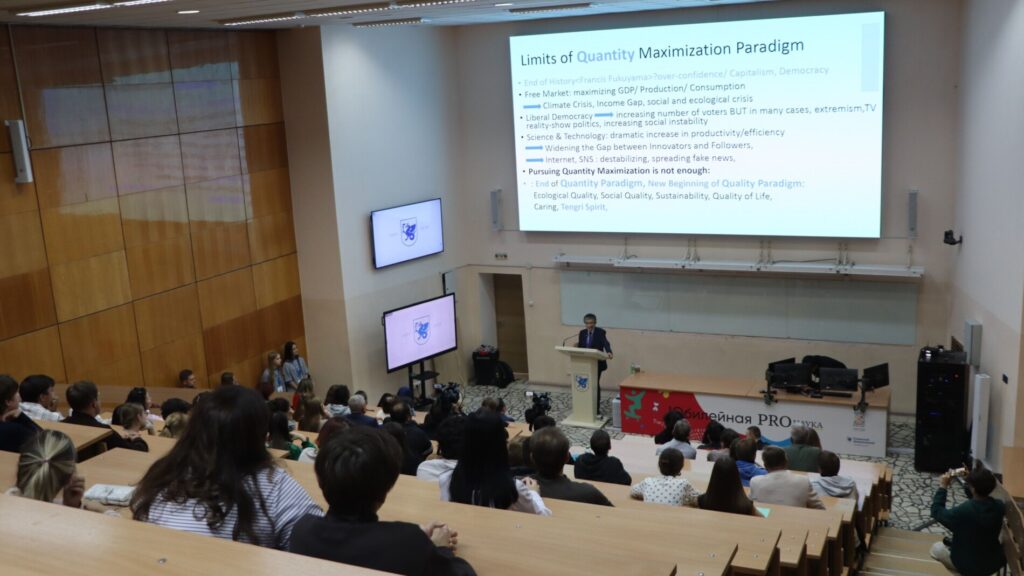
Chung Rae-kwon, Nobel Peace Prize laureate, Chairman of the Global Energy Prize International Award Committee, Director of the Ban Ki-Moon Foundation, Special Advisor on Climate Policy to the Minister of Foreign Affairs of the Republic of Korea, addressed the attendees during the 20th anniversary edition of PRO Science at KFU, held as part of the 5th Kazan Global Youth Summit. The topic of his open speech was A Bottom-Up Approach to Career Development and Sustainability in the Age of Artificial Intelligence and the Climate Crisis.
The Nobel laureate began his address by describing the current situation as a dual challenge. Today’s students, he explained, are facing a convergence of two global threats: the rapid advance of artificial intelligence and the climate crisis.
«The international community is discussing and addressing climate change. The key issue is that we are approaching the solution within the old paradigm, even though this is a new challenge. We cannot solve this problem with quantity — we need quality,» stated Chung.
He believes that if consumers begin to choose carbon-neutral products, companies will be forced to take this demand into account and restructure their production chains.
«Government certainly plays an important role, but policy or legislation alone cannot solve this problem. As for businesses, it’s not their job to address climate change,» the Nobel laureate remarked.
He believes that instead of shifting responsibility to governments or companies, each individual should ask themselves what they have done to combat climate change.
«Many of us choose cheaper products that create carbon pollution,» he emphasized.
At the same time, the speaker acknowledged that consumers today objectively don’t have many alternatives. He noted that the market doesn’t yet offer a sufficient number of carbon-neutral products.
«I believe you’ll have to ask companies and governments to make these changes happen,» he told the audience.
The lecture focused on artificial intelligence as well.
«We need to find values that the younger generation will adhere to throughout their lives. AI will have more skills and knowledge, so it will be necessary to be communicative to remain competitive,» he noted.
Dr Chung called for a rethinking of the principles of competition. He urged the audience not simply to think about how to become smarter or more successful than a machine, but to completely change the system. He is convinced that human caring and sharing, a willingness to collaborate, and the ability to listen will become a competitive advantage that no one can program.
Consecutive English-Russian interpretation was performed by International Cooperation Officer of the Institute of Geology and Petroleum Technologies Yury Nurmeev.