

Priority 2030 technology session on energy, nuclear industry, and petroleum complex held at KFU
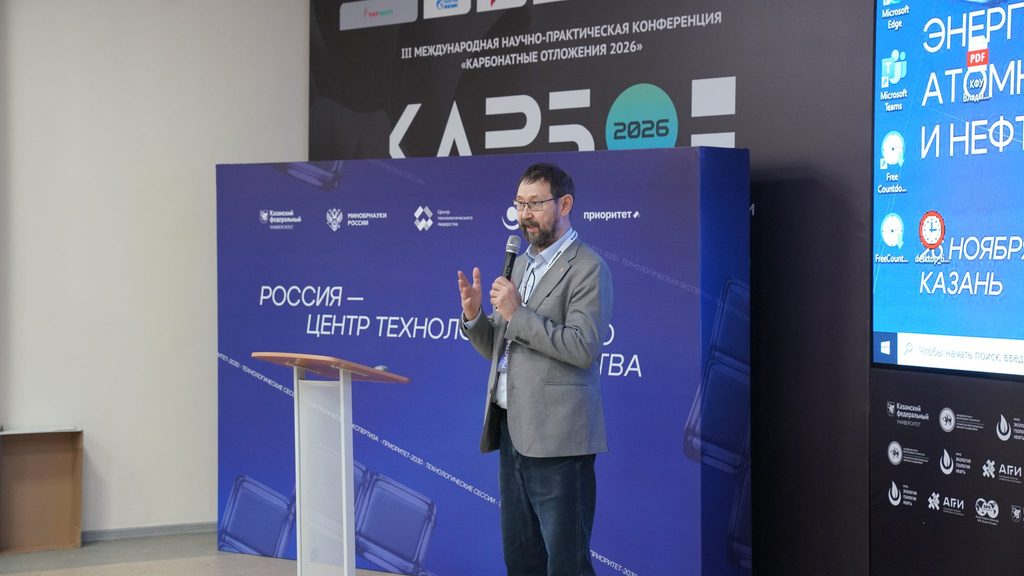
Kazan Federal University hosted a technology session of the Priority 2030 program in the Energy, Nuclear Industry, and the Petroleum Complex track. It was the fifth stage, held in person, of a unified eight-stage review model. The session’s goal was to evaluate technological solutions, results, prospects for practical application of the technologies, and cooperation with industry.
The event took place at KFU’s Institute of Geology and Petroleum Technologies (IGPT). Participants were welcomed by Rifkat Minnikhanov, President of the Tatarstan Academy of Sciences; Vladimir Chuprov, an expert at the Center for Technological Leadership; and Danis Nurgaliev, Director of IGPT.
The head of the Tatarstan Academy of Sciences described the end-to-end system of financial support for technology and research projects in the Republic of Tatarstan to representatives of universities from across the country.
Since 2023, the republic’s Investment and Venture Fund, with support from the Tatarstan Academy of Sciences, has financed 87 projects. Their combined budget is 12.9 billion rubles, Minnikhanov reported.
«Each stage needs its own kind of support: a grant at the start, venture investment for growth, and a targeted loan for moving into production,» he stressed. «Right now, scientists take part in 17 percent of projects. To increase that share, it is important to introduce researchers to the needs of enterprises as early as possible.»
The Tatarstan Foundation for Science and Technology helps research teams test an idea, get an expert assessment, and find an industry partner.
«The foundation has supported 158 projects across five areas. Grants have exceeded 680 million rubles. Most of the work is in basic and exploratory research. Scientific and technical development leads in funding, with more than 410 million rubles for 61 projects. I would separately note the contribution of business: more than 850 million rubles in private investment has been attracted to research and development,» Rifkat Minnikhanov said.
After the opening ceremony, participants began presenting their projects. The work was organized into four tracks:
- Field development and the digital oilfield.
- Electric power, renewable energy, and distributed generation.
- Oil and gas infrastructure, materials, and oil and gas chemistry.
- Nuclear power, energy storage, and hydrogen.
First, university teams presented their developments to one another, answered questions, and discussed possible cooperation. This stage was called Peer to Peer. Then the strategic technology projects were presented to the experts. In this second stage, called the Expert Pipeline, reviewers evaluated the soundness of the technological solutions, their applicability, their payback, and many other factors.
Nurgaliev presented the KFU’s project «Developing Technologies for Unconventional Hydrocarbon Resources and Late-Stage Fields» to participants and experts.
«Kazan University was not chosen as the venue for the strategic session by accident. It is a sign of respect. In the morning, we presented our strategic project, which combines 20 interrelated smaller projects, to our colleagues and discussed how and with whom we can work in cooperation. After lunch, I told the experts in more detail what we have already done, what we are working on now, and where we plan to go. Our project, which is centered on artificial intelligence technologies, is one of the largest in the pool. It covers a broad range of tasks, from developing late-stage fields to tapping hard-to-recover reserves. The experts had questions and recommendations, which is very important for us. These are the people who will present our strategic project and the technology we are creating to Sociocenter,» the IGPT director said.
Valery Krivetsky is Head of the Research Laboratory for Engineering and Technologies of Chemical Power Sources at the Institute of Electric Propulsion at MIPT. His team developed a project to create a family of high-capacity lithium-ion batteries.
«It is critically important for our country to create such batteries. The need comes from the need to increase the autonomy of mobile electronics and robotics. They can also be used in a certain segment of electric transport,» he explained. «We are developing a technology that will allow us to replace, at least in part, the graphite in batteries, whose capacity is not high enough, with silicon. Its capacity is ten times greater than that of graphite. But silicon is a very finicky material. During operation it expands considerably and gradually begins to break down, which significantly shortens battery life. In our project, we are trying to tame silicon. This requires solving a great many different problems, and for that purpose we conduct research and engineering and technology work.»
Vadim Kupavykh, Head of the Department of Research and Development at Ufa State Petroleum Technological University, spoke about services for autonomous field management.
«Our project, ‘Technological Engineering and Autonomization of Production Processes,’ is a platform for autonomous field management, intended to make the most effective use of the potential of fields with hard-to-recover reserves and those in hard-to-reach areas,» the specialist said. «Existing digital services are not enough. They do not account for a whole range of complications, from hydrate formation to paraffin deposits. Specialized solutions will help reduce operating and capital costs. As the technologies develop, facilities will become sparsely staffed. At the same time, we do not plan to cut people. The goal is to free up process engineers’ time for strategic tasks. That is the main value of the project for the industry.»
According to Maxim Delov, Deputy Director of the Institute of Nuclear Physics and Technology at the National Research Nuclear University MEPhI, the strategic technology project «Nuclear Technologies and New Materials» is meant to expand the university’s chain of partners.
«Our project is comprehensive: it includes nuclear power, nuclear fusion, plasma technologies, and work with materials. What is distinctive about our work under the Priority 2030 program is that we are developing nuclear technologies for both traditional and new markets. For example, as part of a startup, the first prototypes of accelerators for processing cellulose have been launched,» he explained.
Dmitry Yuryev, an expert at the technology session, believes the developments presented by the universities respond to current challenges facing Russia’s oil and gas complex.
«It is clear that we are now talking about early-stage technologies, TRL 4–6, not 7–8–9. In some cases these are just ideas, and in others they are prototypes and laboratory samples,» he clarified.
The expert noted that the industry now needs technological ideas capable of delivering a breakthrough like the one hydraulic fracturing once made for low-permeability reservoirs. At the same time, he said, it is necessary to combine freedom of scientific inquiry with an understanding of when and how a technology will be implemented.
«It is important not to lose the boundlessness of scientific thinking, but at the same time to think about when and how this will reach production. Of course, it is good if a problem is solved in principle, but if it is solved in 2040, its relevance will be lost,» he stated.
Large companies usually invest in technology development at the initial stage but cannot become equipment manufacturers themselves, the expert stressed, and projects often get stuck in the early stages. Yuryev believes this gap can be bridged if, within universities, different teams focus on generating ideas and on bringing technologies up to an industrial level.
In total, the participating universities presented 250 innovative developments in 12 areas during the session. The session was organized by the Ministry of Science and Higher Education of the Russian Federation, Sociocenter, and Gazprombank’s Center for Technological Leadership. Following the session, the experts are to prepare conclusions on the strategic technology projects.