

Unique master class conducted at University Clinic by Chinese surgeons
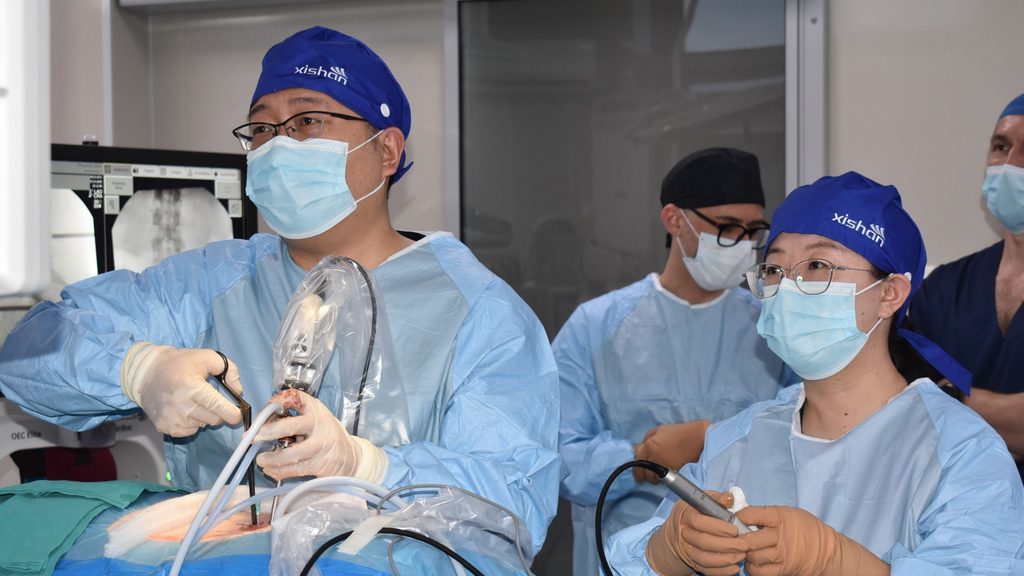
At the University Clinic of Kazan Federal University, a master class using the breakthrough AUSS technology (unilateral uniportal non-coaxial endoscopic spine surgery) was held for the first time in the Volga Federal District.
Professor Song En, an orthopedic surgeon from the Department of Sports Surgery at Kunming Medical University and the developer of the technique, came to Kazan from China together with specialists Qu Yang and Li Jizheng. The Russian expert team included Andrey Vershinin, a neurosurgeon at the University Clinic of Kazan University, and Alexander Aleinik, a neurosurgeon at the University Clinic of the Privolzhsky Research Medical University (Nizhny Novgorod).
For a long time, endoscopic spine surgery evolved according to the principle of ‘one incision, one axis.’ In the conventional approach, the endoscope and surgical instruments were inserted through a single tube, which severely limited the surgeon’s freedom of movement. The surgeon could work only within a narrow corridor, and in complex clinical cases, such as severe spinal canal stenosis or multilevel disc herniations, surgeons often had to abandon the minimally invasive approach in favor of open surgery.
AUSS breaks this stereotype. As Dr Vershinin explained, the essence of the technique is that the endoscope and working instruments are introduced independently of one another. This became possible thanks to a fundamentally different approach to organizing surgical access, developed by Professor Song En.
“The key idea is ‘one incision, two hands.’ Previously, the instruments and camera passed through the same tube. It was like trying to eat with a single chopstick. Now the surgeon has two independent points of support: the endoscope and the instrument. With this technique, through a single 1.5–2 cm incision, the surgeon works with two hands: one holds the endoscope, while the other manipulates the instruments. This provides tremendous freedom of movement and a wide field of view that is unattainable with traditional endoscopy. The freedom of manipulation has increased many times over,” he explained.
During the master class in Kazan, two patients with spinal disc herniations underwent surgery. Participants observed the surgeons’ procedures through a live broadcast from the operating room. Under the guidance of the experts, trainees were also able to practise the key stages of endoscopic interventions on simulator models specially developed for the course. This format allows surgeons not only to understand the principles of the technology but also to acquire initial manual skills in handling the endoscope and instruments before introducing the method into their own clinical practice.
“The goal of modern surgery is not merely to reduce the size of the incision, but to ensure a complete solution to the surgical problem with minimal trauma. For us, it is fundamentally important not only to master the technology but also to transfer this experience to colleagues. The more surgeons are able to perform high-quality endoscopic procedures, the more patients in different regions will receive treatment with minimal surgical trauma,” noted the neurosurgeon from the University Clinic of Kazan Federal University.
In China, AUSS technology has proven highly successful. To date, more than 40,000 procedures have been performed. Surgeons use it in 400 hospitals across 29 provinces of the People’s Republic of China.
“Thanks to its minimally invasive nature, this technique is almost universal. If a patient cannot tolerate general anesthesia, which is required for most operations, this procedure can be performed under local anesthesia. The surgical intervention is indicated even for the most severely ill patients with multiple comorbidities,” said Professor Song En, the developer of the technique.
Participants in the event stated that they were ready to actively implement the knowledge gained during the training course in clinical practice.
“I work at the University Clinic of the Privolzhsky Research Medical University in Nizhny Novgorod. We also have a training base where educational courses and seminars are held. Together with our Chinese colleagues, we conduct research; we will summarize and publish the results, share them with colleagues at conferences, invite trainees and colleagues from other regions to our center, and disseminate the technique. It has already spread throughout China, and I believe that within one to two years it will be widely used across Russia,” said Aleinik.
The patients who underwent the demonstration procedures are feeling well and are preparing for discharge.