

Engelhardt Astronomical Observatory marks 125th anniversary
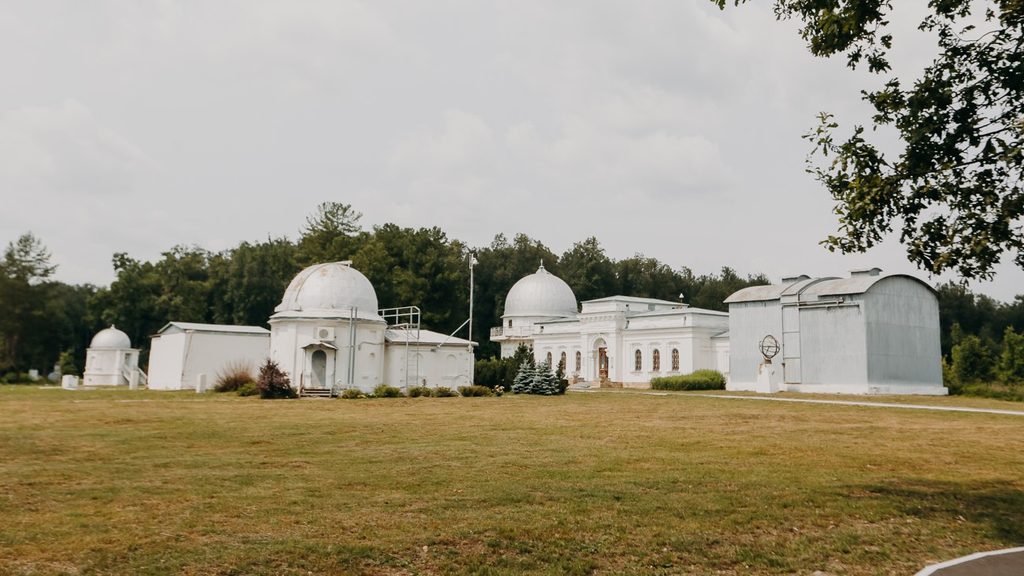
Today, September 21, marks the 125th anniversary of the founding of the Engelhardt Astronomical Observatory (EAO) of KFU.
Throughout its history, the observatory has remained one of Russia’s leading research centers, widely recognised both nationally and internationally. The achievements of Kazan astronomers have earned worldwide scientific recognition, while findings produced at the EAO have been incorporated into astronomy textbooks and monographs. The observatory has served as an educational and research base for practical training of students from astronomy departments across Russia, as well as a major center for public outreach and culture.
The construction of the suburban observatory, located 20 kilometres from Kazan, between 1899 and 1901 was undoubtedly one of the most important milestones in the development of the Kazan school of astronomy. It was also a major achievement of Dmitry Dubyago, astronomer and rector of Kazan Imperial University.
The observatory’s instruments, library and financial resources were donated to the university by Vasily Engelhardt (1828–1915), a noted astronomer and public figure. Engelhardt began studying astronomy at around the age of 50. He built and equipped a private observatory in Dresden with excellent instruments and, over the next 25 years, observed minor planets and nebulae, earning the respect of the international astronomical community.
As his health declined, Engelhardt became concerned about the fate of the instruments to which he was deeply attached. Having maintained close ties with Russia, he had begun corresponding in the early 1880s with Dmitry Dubyago, then an astronomer at Pulkovo Observatory and a professor at St Petersburg University. Their scientific correspondence gradually developed into a friendship. It was this friendship with Dubyago that led Engelhardt to choose Kazan University as the recipient of his gift.
In the summer of 1897, Engelhardt informed the university of his intended donation, which it gratefully accepted. In December that year, he sent all the equipment from his Dresden observatory to Kazan. Dubyago, who soon became rector, began lobbying the government for land and funding for a new observatory. The Engelhardt Observatory was formally opened on September 21, 1901, and quickly gained international prominence.
Early directors and researchers
After Dmitry Dubyago’s death, leadership of the observatory was assumed by his students and close associates, Vladimir Baranov and Mikhail Grachyov.
Vladimir Baranov (1872–1942) spent many years conducting gravimetric surveys in the Volga region. Using the EAO refractor, he carried out positional observations of minor planets, comets, nebulae, variable stars and double stars. In the early 1930s, Baranov established a geodesy specialisation at Kazan University and also served as the university’s vice-rector and dean of the Faculty of Physics and Mathematics.
Mikhail Grachyov (1866–1925), Dubyago’s closest associate, devoted considerable effort to the construction of the Engelhardt Observatory. As an observational astronomer, he conducted research using the meridian circle and refractor. In 1918, he became director of the EAO. A distinguished scholar and capable administrator, Grachev succeeded in preserving the observatory’s equipment, research focus and operations during the difficult years of revolutionary upheaval and economic devastation.
In 1925, Avenir Yakovkin (1887–1974) became head of the Engelhardt Observatory. He pioneered astrophysical research at Kazan University. His photographic records of stellar spectra laid the foundations of the EAO’s glass-plate archive. Yakovkin carried out extensive observations with a heliometer and, after processing the data, obtained refined values for the physical libration of the Moon. He was also the inventor of several original astrophysical instruments.
After Yakovkin moved to the Department of Astronomy in 1931, the observatory was headed by the energetic 24-year-old Dmitry Martynov (1906–1989). From 1939, Martynov combined the directorship of the EAO with leadership of the newly established Department of Astrophysics. Between 1951 and 1954, he also served as rector of Kazan University.
After leaving Kazan in 1954, Martynov headed the Department of Astrophysics at Moscow University. From 1956, he directed the Sternberg State Astronomical Institute for two decades. An outstanding astrophysicist and organiser of systematic astrophysical research at the Engelhardt Observatory, Martynov made major contributions to the study of variable stars, particularly eclipsing binaries, which he observed and interpreted theoretically.
During the Great Patriotic War, while serving as EAO director, Martynov devoted considerable effort to building a telescope based on the then-new Schmidt optical system. Even after moving to Moscow, he never lost contact with the Engelhardt Observatory, where he had spent 23 years. He continued to follow its research and sought opportunities to assist Kazan astronomers. In tribute to Vasily Engelhardt, Martynov — then director of the Sternberg Institute — secured the naming of the institute’s new 1.2-meter telescope in Crimea as the Vasily Engelhardt Telescope.
Long-term research programs
A defining feature of the EAO’s scientific work has been its commitment to fundamental astronomical questions requiring long-term observing programmes and in-depth theoretical study. Research in fundamental astrometry was undertaken in collaboration with other observatories.
Long series of stellar-declination observations were obtained using the meridian circle. These efforts resulted in Fundamental Catalogues of Faint Stars and a catalogue of geodetic stars. The work was carried out by Ivan Dyukov, Antonina Nefedyeva, L. Smagina (Agafonova), and many other members of the astrometry department.
The study of the Moon’s rotation and shape has been a particularly distinctive area of research at the Engelhardt Observatory. Astronomers have focused on determining parameters of physical libration from observations, which characterise the dynamical figure of Earth’s natural satellite.
Lunar observations began with Alexander Krasnov in 1895. They were subsequently pursued by such prominent scientists as Tadeusz Banachiewicz, Avenir Yakovkin, Anatoly Nefedyev, Shaukat Khabibullin, Igor Belkovich, Naufal Rizvanov and Yury Nefedyev.
Following Dmitry Martynov’s move to Moscow, Alexander Dubyago, professor in the Kazan University Department of Astronomy and founder of the Kazan school of cometary research, was appointed director of the EAO. He was Vasily Engelhardt’s godson. The only one of Dmitry Dubyago’s children to follow in his father’s footsteps, Alexander demonstrated a marked talent for mathematics and astronomy from an early age. His monograph on cometary astronomy remains a seminal work on the fundamentals of comet research.
From 1958, the observatory was led for more than 18 years by Professor Anatoly Nefedyev (1910–1976), a noted specialist in lunar astrometry. His directorship marked an entire era in the history of the Engelhardt Observatory. During this period, all of its departments — the astrophysical, astrometric and lunar divisions, as well as the meteor department established in 1957 under Professor Konstantin Kostylyov — worked actively and productively.
For his exceptional contribution to the first maps of the Moon’s limb zone at zero elevation, a large crater near the lunar south pole was named after Anatoly Nefedyev.
After Nefedyev, the observatory was headed by Professor Oleg Belkovich. He developed an entirely new probability-based approach to processing and interpreting radar observations of meteors. For the first time worldwide, he derived analytical distributions for the amplitudes and durations of meteor radar echoes, accounting for the random positions of reflecting points along meteor trails. He also obtained distributions of the heights of such reflecting points and established a basis for calculating the flux density of incoming meteoroids from radar observations.
Belkovich co-authored two state standards: Meteoric Matter: Terms, Definitions and Letter Symbols and Meteoric Matter: A Model of Spatial Distribution. No equivalent standards have yet been developed internationally.
Modern development
In 1991, Nail Sakhibullin, professor and head of the Kazan University Department of Astronomy, became head of the EAO. He later became an academician of the Academy of Sciences of the Republic of Tatarstan. Sakhibullin made every effort to bring the 1.5-meter telescope into operation; its construction had begun under Anatoly Nefedyev. During a difficult period, he not only preserved the observatory’s scientific staff but also expanded it.
In early 2008, Yury Nefedyev, Doctor of Physical and Mathematical Sciences and professor, became director of the Engelhardt Astronomical Observatory. The observatory was, in the most literal sense, his home: he was born there, grew up in an astronomical environment from early childhood, and went on to author 25 monographs and more than 700 articles.
“Throughout its history, the EAO has been one of the largest research centers, widely known both in Russia and abroad. The achievements of Kazan astronomers have been recognised by the global scientific community. Eleven of our astronomers have had lunar craters, asteroids and comets named after them,” Yury Nefedyev noted. “Over its 125-year history, the EAO’s scientific work has covered virtually all major areas of astronomical research. Vast observational datasets have been collected, more than 3,500 articles and monographs have been published, and new theories and methods for processing observations have been developed. The EAO has served as a research and training base for students from astronomy departments across Russia, as well as a major centre for public outreach and culture.”
In 2009, Kazan hosted the international conference Astronomy and World Heritage: Through Time and Across Continents from August 19 to 24. Recognised by UNESCO on January 17 that year as a principal event of the International Year of Astronomy, the conference initiated efforts to place Kazan Federal University’s astronomical observatories on the UNESCO World Heritage List.
The observatory’s largest operating visual telescope — a refractor — was restored. Modern security and communication systems were installed, and the grounds were redeveloped. A sundial was built to support guided tours, while the observatory was equipped with solar telescopes fitted with BF 0.5–0.8 Å blocking filters. Work also began on establishing an interregional metrological centre at the EAO.
Significant support for these initiatives came from Alexey Lavrov, then Deputy Minister of Finance of the Russian Federation; Vyacheslav Sasyuk, deputy director of the observatory; and Renat Zagretdinov, associate professor at the Department of Astronomy and Space Geodesy.
A modern planetarium was constructed, and in 2023 the Engelhardt Observatory was included on the UNESCO World Heritage List. Traditional public-engagement work at the observatory was also significantly developed through the efforts of Inga Dubyago and Margarita Kibardina. Visitors were given the opportunity to explore the mysteries of the Universe first-hand by observing celestial objects directly through a telescope eyepiece.
Plans were also announced to transform the EAO grounds into a unique astronomical park — an open-air museum unlike any other in the world.
Looking ahead
The EAO is now headed by Vladislav Ilyin, who has been making major efforts to expand the observatory’s popular science and public outreach activities.
“On September 21, our stellar UNESCO site marks 125 years since its opening,” Ilyin said. “As the world’s only operating university observatory with a planetarium, it has rightfully become a favourite destination for children and adults, residents of the republic and its visitors alike. On this special day, we first of all congratulate and thank our veterans and distinguished staff members, who laid the foundations for the success and renown the site enjoys today. We also extend special thanks to Mintimer Shaimiev and the Revival Foundation for their inspiration and support. It is particularly symbolic that our anniversary year is smoothly giving way to Mintimer Sharipovich’s own anniversary year.”