

Inter-university team seeks ways to improve cement quality
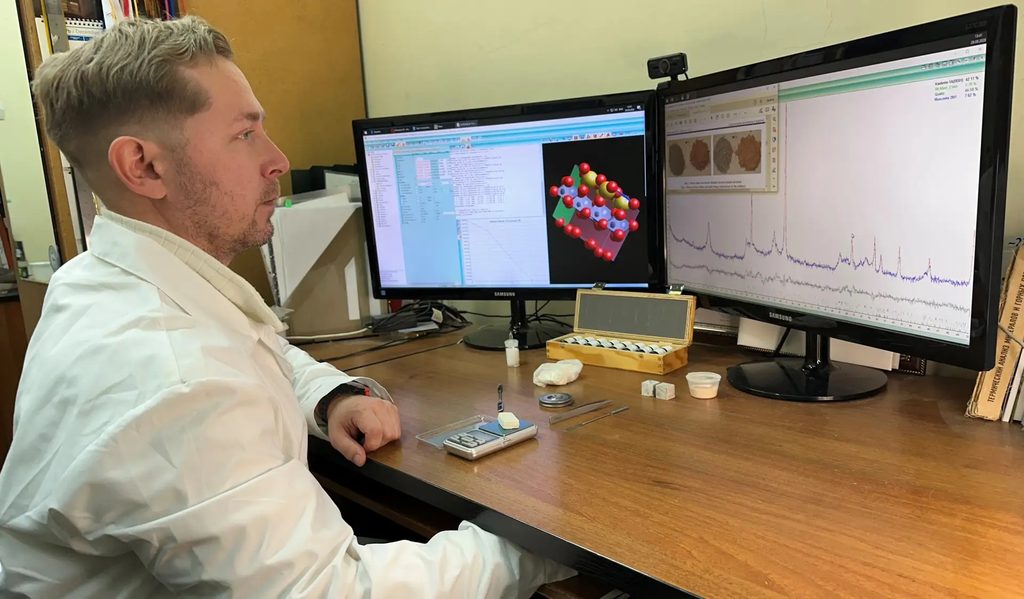
Researchers from the Institute of Geology and Petroleum Technologies at Kazan Federal University and Kazan State University of Architecture and Engineering have developed a reactive mineral additive for producing high-strength cement.
The development will help reduce the use of Portland cement clinker, the most expensive component of cement, whose production is highly energy-intensive and releases large amounts of carbon dioxide into the atmosphere.
“We have been working with colleagues from Kazan State University of Architecture and Engineering for the past 15 years to find alternative construction materials. This year, our project, Chemical Technology for Low-Carbon Cements Using Reactive Aluminosilicates Derived from Activated Montmorillonite Clays, received a grant from the Russian Science Foundation,” said Alexey Yeskin, Associate Professor in the Department of Mineralogy and Lithology. “Conventional cement additives — blast-furnace slag, fly ash, and silica fume — are not available in every region, and their supplies and production volumes are limited. This has created a need to identify new, widely available and accessible raw materials. Montmorillonite clays are widespread, but in their natural state they are insufficiently reactive to serve as effective cement additives, even when their montmorillonite content is high. The first step is to determine the conditions under which these clays become effective pozzolanic additives for cement.”
The Kazan researchers conducted a comprehensive series of laboratory investigations to examine how heat treatment and grinding fineness affect the reactivity of montmorillonite clays. Their findings are presented in an article published in the journal Izvestiya KGASU.
“Heat treatment does more than simply dry the clay. When heated, its minerals change from a stable crystalline state to a less ordered — and more reactive — state. Our data show that finely ground, thermally activated clays significantly improve the strength of hardened cement paste compared with untreated raw materials,” Yeskin explained.
To maximise this effect, several parameters must be taken into account: the clay’s chemical and mineralogical composition, the temperature and duration of heat treatment, grinding conditions, and particle size.
The researchers found that the clay’s effectiveness in hardened Portland cement paste depends less on its montmorillonite content than on its aluminium oxide (Al₂O₃) content. Particle size is equally important: ideally, 90 percent of the particles should be no larger than 50–60 µm. Under these conditions, up to 10 percent of Portland cement can be replaced without substantially reducing the strength of the hardened cement paste.
The project team is confident that applying the findings of this research into montmorillonite clays will help create exceptionally strong materials and make construction more environmentally friendly and cost-effective. It will also broaden the cement industry’s raw material base by creating demand for widely available local clay deposits.