

KFU lab studies to help enrich the archeological chronicles of Europe
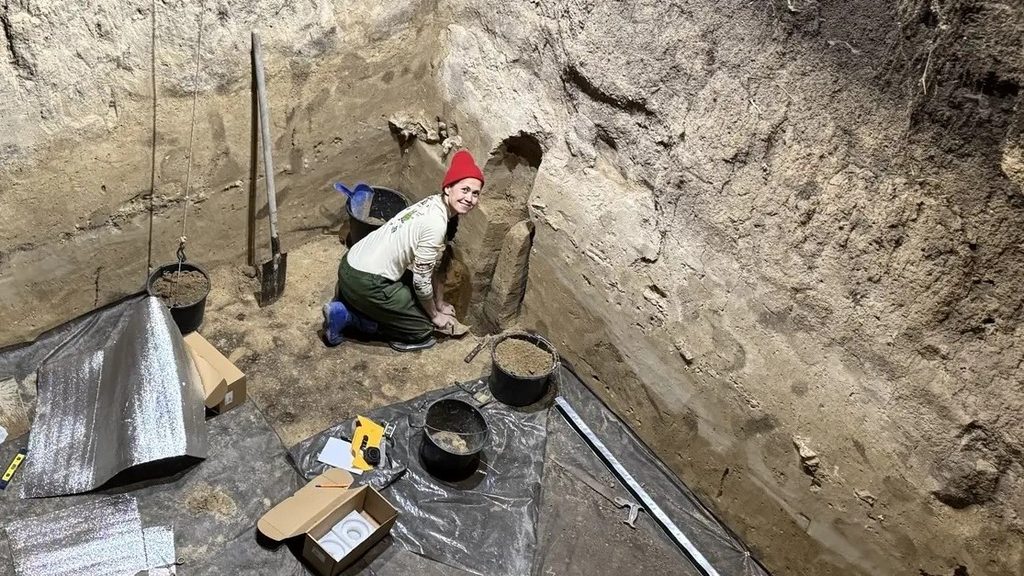
Paleomagnetic analysis of loam samples from the Kostenki–Borshchevo historical, cultural and archaeological complex, which contains Paleolithic human occupation sites, is expected to help reveal what Earth’s geomagnetic field was like 41,000 years ago and fill a gap in the archaeological record. The research is being conducted by Dilyara Kuzina, a leading research fellow at the Institute of Geology and Petroleum Technologies.
“It all began when Sergey Lisitsyn, a senior research fellow in the Paleolithic Department at the Institute for the History of Material Culture of the Russian Academy of Sciences, approached me with a proposal to carry out paleomagnetic studies of samples from excavations at Borshchevo 5, a prehistoric human dwelling site within the archaeological complex,” Dilyara Kuzina explained. “In early October, I travelled toVoronezh Oblast and collected geological samples. Our reference marker was the Campanian Ignimbrite ash layer, which formed during an exceptionally powerful eruption of the Phlegraean Fields in Italy 39,000 years ago. Samples were taken from above and below this layer. The sampled sequence is more than a metre thick, and the archaeological layers under investigation date from 25,000 to more than 40,000 years ago. My task is to study the behaviour of the magnetic field.”
The KFU researcher hopes to find evidence in the samples of the Laschamp geomagnetic excursion — a brief change in Earth’s magnetic field that occurred approximately 41,000 years ago, during the last glacial period.
According to Sergey Lisitsyn, the European archaeological record contains a gap, a so-called hiatus, of 5,000–6,000 years: there are almost no finds between the early Proto-Aurignacian cultures, which existed 43,000 to 41,000 years ago, and the later Aurignacian cultures, which were widespread 35,000 to 32,000 years ago. The problem is that radiocarbon dating is insufficiently reliable for objects more than 40,000 years old, while other clear chronological markers are scarce.
“The Laschamp excursion and the ash horizon, whose age has been established quite precisely, serve as reference markers. Borshchevo 5 is a particularly promising site for this research because its layers are ideally positioned: the Proto-Aurignacian layer lies directly beneath the ash, while the Aurignacian layer occurs within and above it. If paleomagnetic investigations at the excavation can identify the Laschamp signal close to the archaeological layers, we will be able to correlate different dating methods more precisely and determine whether the hiatus, a prolonged interruption in human occupation of Europe, actually occurred or is instead a consequence of chronological inaccuracies. It is precisely this targeted sampling from the excavation section that offers a chance to obtain these crucial data,” Sergey Lisitsyn emphasised.