

KFU physicists advance research into robust quantum memory
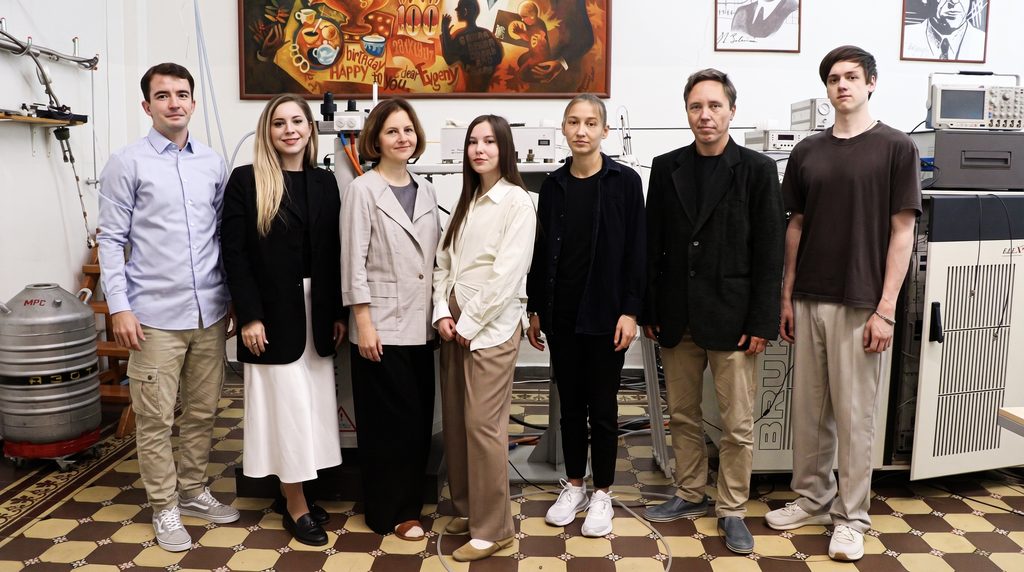
Physicists at Kazan Federal University have carried out a study aimed at developing robust quantum-memory systems, a key technology for secure communications and the storage of processed quantum information.
The work was led by research associate Fadis Murzakhanov and involved researchers from KFU’s Laboratory of Prospective Platforms for Spin Quantum Manipulations and the Altshuler Department of Magnetic Resonance Spectroscopy and Quantum Electronics. The team included Georgy Mamin, associate professor at the Department of Quantum Electronics and Radiospectroscopy; Irina Gracheva, associate professor at the Department of General Physics; chief researcher Marat Gafurov; junior researcher Margarita Sadovnikova; researcher Daria Shurtakova; and design engineers Yulia Ermakova and Ekaterina Dmitrieva.
The results have been published in The Journal of Physical Chemistry Letters.
Shielding Quantum Information
One of the central challenges in quantum technology is the extreme fragility of quantum states. External magnetic and electric fields, as well as atomic-scale fluctuations, can rapidly destroy encoded information.
The KFU researchers focused on selective control of remote carbon-13 nuclei embedded in a silicon-carbide semiconductor crystal. These nuclei are of particular interest because of their relative inertness and resilience to external disturbances.
“These nuclei are inherently protected from surrounding electromagnetic noise and can store information reliably,” Murzakhanov said. “This removes the need for complex isotopic purification of the entire material. At the same time, to improve the crystal’s properties, it was partially modified using nonmagnetic silicon-28 isotopes.”
Key Experimental Results
Using nitrogen-vacancy, or NV, centres — atomic-scale defects commonly associated with diamond-based quantum systems — the researchers achieved several significant results.
First, they observed nuclear Rabi oscillations in remote carbon-13 atoms for the first time. Rabi oscillations describe the coherent exchange of energy between a particle and an external electromagnetic field. Their observation confirms full coherent control over the quantum states of the carbon-13 nuclei.
Second, the team recorded a redistribution of intensities in nitrogen-14 spectral lines. The effect was detected using a triple-resonance technique after saturating carbon-13 nuclear transitions with energy.
Third, the researchers experimentally established an indirect magnetic interaction between nitrogen and carbon nuclei through simultaneous monitoring of their signals.
“Our experiment showed that nitrogen and carbon atoms in the crystal form a network of interconnected nuclei through the electron cloud of the NV center,” Murzakhanov explained. “An effect on one nucleus influences another.”
By optimizing their measurement methods, the researchers achieved a signal-readout contrast of 35 percent — a record level of sensitivity for detecting the signal in this experimental setting.
Toward Practical Quantum Devices
According to the research team, the practical value of the work lies in identifying and testing materials that could eventually be used to build real quantum devices.
“The results lay the groundwork for the development of long-lived quantum memory,” Murzakhanov continued. “Science is now undergoing a global technological shift from unstable electron qubits to long-lived nuclear systems. Electrons respond too strongly to their surroundings and lose information quickly, while atomic nuclei can retain data for much longer.”
The findings support the idea that carbon-13 nuclei can act as reliable microscopic “safes” for quantum information. Nitrogen-vacancy centres, meanwhile, can transfer information to these nuclei and control their states in a fixed magnetic field.
The researchers believe this platform could contribute to the future development of a fully secure quantum Internet. Unlike conventional communication networks, whose data can potentially be intercepted and copied, a quantum network encodes information in the quantum states of individual particles, making unauthorized observation fundamentally detectable.
“Studying nuclear-spin behaviour with a multifunctional spectrometer helps us understand how valuable information could be transmitted over long distances without distortion,” Murzakhanov added.
Silicon Carbide as a Scalable Platform
Silicon carbide is especially promising because it is already manufactured on an industrial scale. The material is widely used in power electronics for charging stations and modern vehicles.
“If the quantum properties we have identified can be used in practical memory components, they will not need to be produced using unique laboratory equipment,” explained Murzakhanov. “The technology could be adapted to the same factories and production lines that already manufacture conventional microelectronics for automobiles and smartphones, substantially simplifying the adoption of quantum technologies.”
The study confirms silicon carbide’s status as one of the most promising materials for quantum technologies, the researchers said.
Next Steps
The group’s next objective is to scale up the system. After studying in detail the interaction between a single electron qubit and remote carbon-13 nuclei, the researchers plan to combine them into full multiqubit quantum registers.
This will allow the team to test how reliably several interconnected nuclear spins can exchange information and perform basic logical operations inside a crystal.
“Another important task is to investigate temperature regimes,” Murzakhanov concluded. “We want to determine how stable the nuclear interaction we observed remains at higher temperatures. Understanding these mechanisms will allow us to assess more accurately how close we are to quantum memory that can operate reliably without complex laboratory equipment—bringing the technology closer to everyday practical use.”