

KFU scientists comment on the importance of resolution adjustment for rock studies
The more detailed the digital rock model, the more accurate the calculations should be – at first glance this seems obvious. But our colleagues have shown that for different properties the limit of useful detail occurs in different ways.
The researchers scanned the same sample of Berea sandstone six times, each time increasing the resolution, and tracked how the porosity, pore structure and ability of the rock to pass fluid changed. The results of the study, conducted with the support of the Russian Science Foundation, were published in Advances in Water Resources.
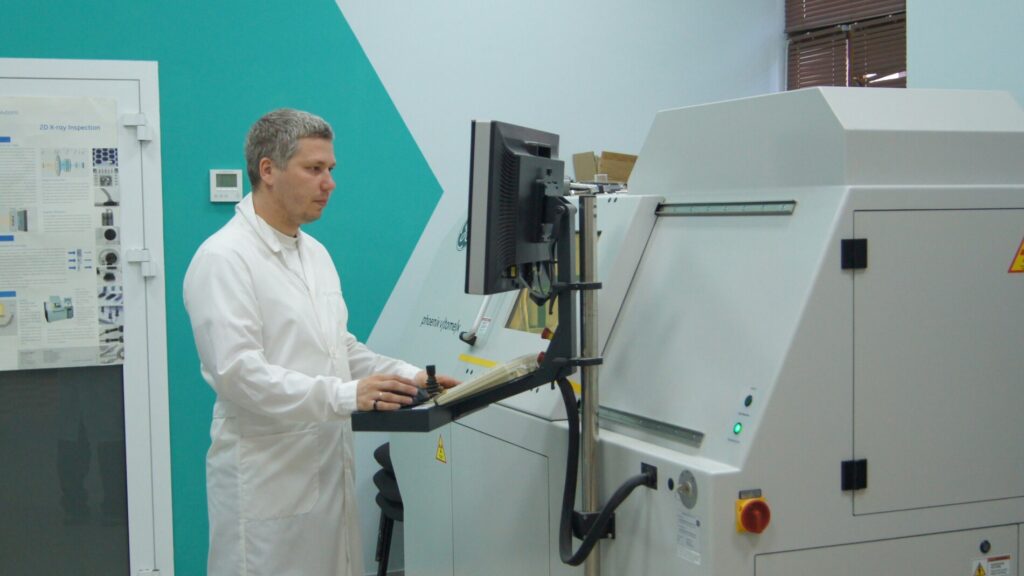
The digital core is obtained using an X-ray microtomograph. The device takes pictures of the sample from different sides, and the computer assembles the images into a three-dimensional model. It shows pores and channels connecting them – a kind of labyrinth through which liquid moves. Based on its design, you can calculate how much empty space the rock contains and how easily it allows water, oil or gas to pass through.
Usually, when increasing resolution, it is necessary to reduce the size of the sample under study. This makes it difficult to know whether the differences are due to more detail in the image or to the heterogeneity of the rock itself. Geologists solved this problem by combining all six tomograms and highlighting the same area about 1.43 millimeters in size. The size of the voxel (volumetric image element) decreased from 16.3 to 1.6 micrometers.
“It was important for us to compare not just similar fragments, but the same physical section of sandstone. Using each model, we assessed the volume and connectivity of pores, their internal surface area, and the tortuosity of fluid paths. The permeability was calculated by three independent computer methods to check whether the general pattern is maintained,” says Rail Kadyrov, a senior researcher at the Laboratory of In-Situ Combustion.
The result turned out to be ambiguous – and this is where its practical value lies. For the associated porosity and tortuosity of the main fluid paths in the studied sandstone, a voxel of about 3 to 4 micrometers was sufficient: further increase in detail hardly changed these indicators. But the internal surface and complexity of the pore space continued to change noticeably even at 1.6 micrometers. Permeability decreased with increasing detail in all three computer calculations, although the resulting values varied. This shows that the permeability calculation is sensitive not only to the image resolution, but also to the chosen modeling method. Therefore, sufficient resolution for permeability must be determined separately.
“Maximum resolution does not always mean maximum benefit. If the desired indicator almost does not change, further complication of the model only increases the volume of data and calculation time. Therefore, the resolution should be chosen not in general to be as high as possible, but for a specific task,” explains project lead Timur Zakirov, Chair of the Department of Mathematical Methods in Geology.
The threshold of about 3 – 4 micrometers so far applies only to the Berea sandstone studied by specialists. In carbonates, clayey and low-permeability rocks, pores of a completely different size may be decisive. The next step is to check how the conclusions are affected by the way the pores and minerals are separated in the image, the type of rock and the size of the volume being studied. As a result, scientists want to move from the rule ‘the more detail the better’ to a more useful principle: getting exactly as much detail as is actually needed for a particular calculation.