

KFU’s mathematical models predict the behavior of thousands of molecules in shale rocks during hydrothermal exposure
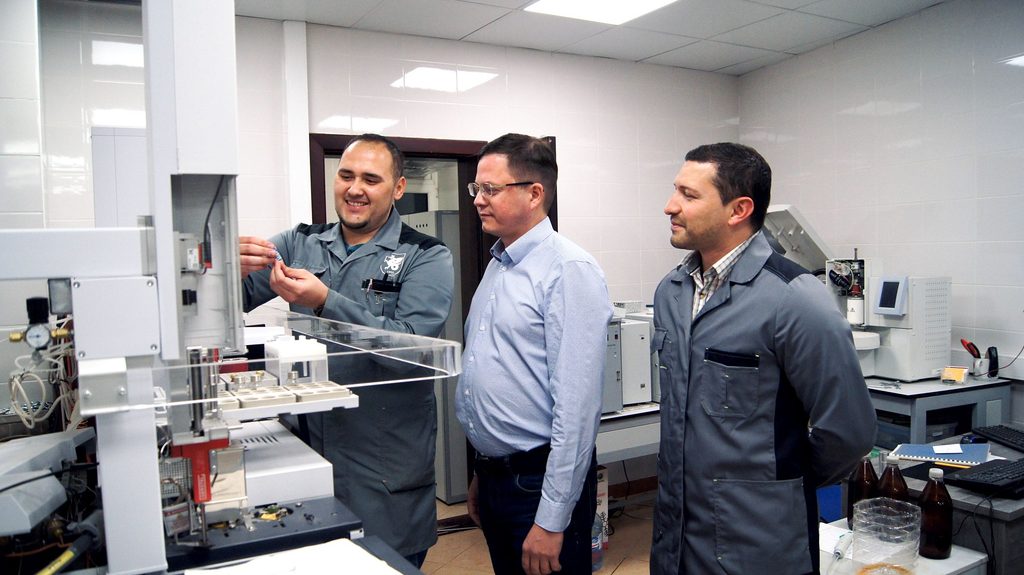
Scientists at Kazan Federal University’s Institute of Geology and Petroleum Technologies have developed a detailed ‘chemical roadmap’ — kinetic models describing how kerogen and other components of shale rocks are transformed under the influence of supercritical water.
Many people have heard of the shale revolution, but far fewer know what shale oil and oil shale actually are, or what makes developing these resources so challenging. Recent research at Kazan Federal University is opening up new possibilities for the oil and gas industry. The scientists traced the transformation pathways of every key component — solid kerogen, asphaltenes, resins, aromatic compounds, saturated hydrocarbons (the most valuable components of oil), evolved gases, and even the inorganic mineral matrix, which forms the porous medium — during hydrothermal treatment. They then developed a mathematical model encompassing the chemical transformations of these components. The researchers predicted the quantity and formation rate of each product and assessed how temperature and a catalyst affect the final outcome. The findings were published in Fuel.
In addition, the researchers proposed kinetic models accounting for parallel reactions during the conversion of kerogen into light oil, heavy residue, and gaseous products, and compared them with a model describing the process as a single stage. These models draw on an extensive set of experiments in which petroleum source rocks were treated with supercritical water across a broad range of temperatures and reaction times. Accounting for parallel reactions reduced the models’ prediction errors by 16–45 percent, as demonstrated in a second paper published in Fuel.
“We developed and solved a system of mathematical equations describing the behavior of thousands of individual molecules within the rock by grouping them into representative categories: solid kerogen, the chemical components of oil, evolved gases, the rock’s mineral matrix itself, light oil, and heavy residues. We then used experimental data to determine the rates at which these groups of substances transform into one another. This allowed us to calculate the actual rate of each process and its temperature dependence, both in the absence and in the presence of an oil-soluble nickel catalyst capable of penetrating the rock’s organic phase and accelerating useful reactions with lower thermal energy input,” said Alexis Tirado, a researcher at the In-Situ Combustion Laboratory.
The overall process can be likened to developing a precise recipe, except that instead of baking, the researchers are ‘cooking’ rock to produce fuel. To do this, they need to know exactly what transformations each ingredient undergoes.
“For the first time, we have been able to achieve a high level of detail in real time. Previously, most researchers used simplified models. Some treated all liquid products as a single system, while others classified oil shale processing products into just three or four broad categories, such as organic matter, gas,’and solid residue, without accounting for the fact that several parallel processes can occur simultaneously,” explained Guillermo Félix, a researcher at the same laboratory.
Although previously developed mathematical models are useful, they overlook fundamental chemical aspects: high-molecular-weight components do not turn instantly into lighter molecules, such as those found in gasoline. They pass through a series of intermediate stages, behaving differently at each one. The world’s first kinetic model of this kind makes it possible to track the quantities of the main oil fractions simultaneously as they form from kerogen, account for the inorganic mineral matrix and gaseous products, and simulate processes under both subcritical-water conditions (liquid water at high temperatures of 300–350°C) and supercritical-water conditions (above 374°C, when water becomes a highly effective solvent with properties of both a liquid and a gas). It also makes it possible to assess the role of a catalyst — an oil-soluble nickel catalyst precursor — in these processes. This high level of detail will help engineers select optimal operating conditions by revealing not merely whether shale is being converted, but exactly how each molecular fraction forms, persists, and undergoes further reactions.
“Oil shale represents one of the largest untapped hydrocarbon resources on the planet. Countries with substantial resources of this material, including Russia, could benefit significantly from technologies that enable its efficient development,” Félix emphasized.
Using water in subcritical and supercritical states opens up a fundamentally environmentally friendly pathway for the oil and gas industry. Under these conditions, water acts as both a solvent and a chemical reactant. It can penetrate the rock’s pores, dissolve bituminous material, and promote kerogen conversion reactions. Together, these effects can reduce fuel consumption and, consequently, carbon dioxide emissions. In addition, the presence of water suppresses the formation of solid coke — a dense carbonaceous residue that impairs production processes.
The catalyst precursor used in this study has several noteworthy and practically valuable properties that distinguish it from other precursors. It dissolves in oil rather than water. The reagent is of interest as a ‘smart’ catalyst designed according to green chemistry principles and capable of changing its form: it goes precisely where it is needed, operates at lower temperatures, and efficiently accelerates the conversion of heavy fractions into lighter, more useful feedstock for fuel production.
“The proposed kinetic models are indeed an important step forward in the development of hydrothermal treatment technologies. They allow us to understand the mechanisms and identify the main stages of the chemical processes involved, and to predict which products we will obtain under different operating conditions while accounting for the fact that kerogen conversion reactions proceed in parallel. All of this substantially improves the accuracy of the calculations. And, of course, it helps us understand the role of catalysts. In these studies, we showed that using an oil-soluble nickel-based catalyst precursor, which transforms into sulfide nanoparticles during the process, changes the reaction pathway and doubles kerogen conversion compared with the non-catalytic process. Crucially, this produces more of the saturated hydrocarbon fraction and light oil, rather than gaseous products and heavy residue,” concluded Mikhail Varfolomeev, the supervisor of the Russian Science Foundation project and a leading researcher at the Institute of Geology and Petroleum Technologies.
The Kazan University scientists successfully demonstrated that adding a nickel-based catalyst precursor enables a high degree of conversion at lower temperatures and with shorter reaction times. They are among the first to demonstrate that the in-situ conversion of unconventional hydrocarbon resources can be controlled through the use of catalytic systems and the appropriate selection of treatment conditions, with kinetic models validated against an extensive body of experimental results serving as a reliable tool for this purpose. The research was supported by the Russian Science Foundation (grant No. 21-73-30023-П).