

Making roads sturdier: KFU scientists seek new ways to protect bitumen from overheating
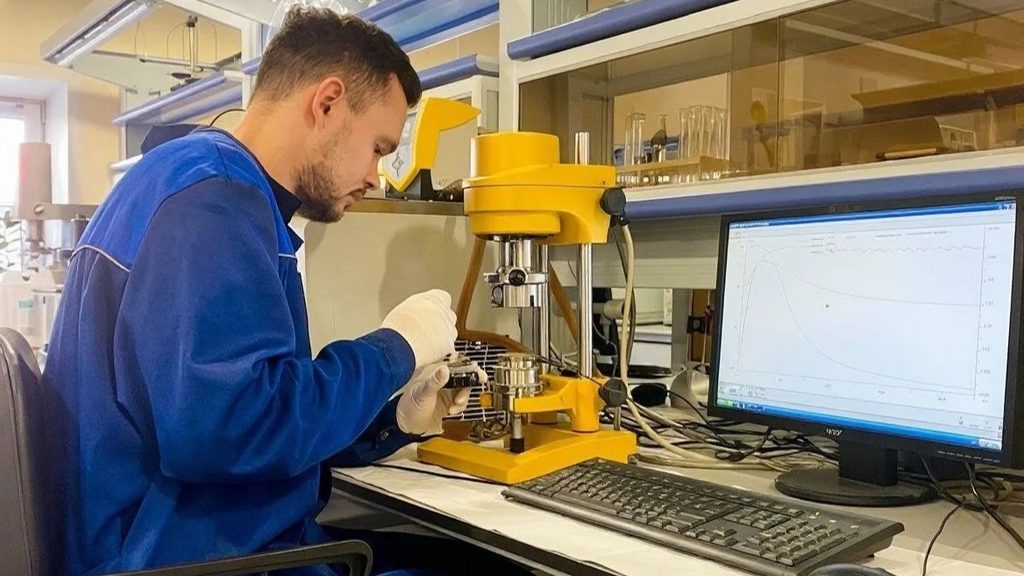
Scientists from the Institute of Geology and Petroleum Technologies, together with colleagues from the Arbuzov Institute of Organic and Physical Chemistry of the Kazan Scientific Center of the Russian Academy of Sciences, have determined the composition of a road binder for asphalt to withstand high temperatures.
A binder is a material, typically bitumen, that glues mineral components (crushed stone, sand, and mineral powder) together to form a single, durable layer of asphalt concrete.
According to Alim Kemalov, Head of the Department of Oil, Gas, and Carbon Materials Technology, bitumen begins to break down already during the asphalt production stage.
«When asphalt concrete is prepared, the bitumen becomes extremely hot: at the points of contact with the hot crushed stone and heating elements, the temperature rises to extreme levels. At this point, light fractions of the bitumen begin to evaporate, and the bonds between molecules are broken. The material degrades, losing strength even before it is laid into a web,» he noted.
Kazanian scientists conducted a detailed study of the degradation processes of unoxidized polymer-modified binders based on vacuum petroleum residue.
To determine what happens to bitumen when heated, the researchers used simultaneous thermal analysis: they simultaneously monitored the change in sample mass and the amount of heat it absorbed or released. This allowed them to measure key parameters of durability: the energy required to initiate degradation and the degree of chaos in the material’s structure.
It turned out that just five percent SBS (styrene-butadiene-styrene) polymer significantly strengthens the mixture. The polymer acts as an invisible mesh: it holds light, mobile molecules and prevents them from escaping quickly. To destroy such an ordered structure requires more energy, so the polymer-based binder can withstand higher temperatures. But if the mixture is overheated significantly, the polymer network collapses, and then deteriorates very quickly.
Sometimes a plasticizer (such as vacuum gas oil) is added to the bitumen to prevent the road from cracking in the cold.
«We found that a low-molecular-weight plasticizer makes the molecules more mobile, the structure becomes ‘loose,’ and the bitumen deteriorates more easily when heated,» said Rustam Akhmetzyanov, assistant professor at the Department of Oil, Gas, and Carbon Materials Technology.
The same thing happens if the feedstock contains too many asphaltenes — heavy components of oil. They don’t interact well with the polymer and clump together into dense clumps. This results in a protective network with holes, and its heat resistance decreases.
«Our experiments showed that increased asphaltene content in the feedstock accelerates the degradation of unoxidized polymer-modified binders because they interfere with the formation of a uniform protective network. We concluded that traditional bitumen, which contains a high proportion of plasticizer and asphaltenes, is the most vulnerable to overheating,» explained Dr Akhmetzyanov.
We also determined how binders behave in different gas environments. For example, in an inert atmosphere (argon), the molecules disintegrate gradually, leaving a dense residue. In air, however, the process is divided into two stages. First, a protective carbon layer forms on the surface, and then, at high temperatures, active combustion begins. This is important to consider in production: even small changes in heating conditions can significantly alter the lifespan of the binder.
Scientists are confident that the durability of a road depends on its composition, which must be determined taking into account many factors, including production conditions.
Having studied the breakdown mechanisms of organic components of binders at high process temperatures, Kazan researchers developed formulas and identified parameters that allow us to predict the binder’s resistance to heating. The results of the study were published in the journal Petroleum Chemistry.
Since scientists have learned to measure and control bitumen’s resistance to overheating, this means that in the future, it will be possible to tailor road mixtures to specific plants and operating conditions.