

KFU scientists develop a unified theory of oscillations in liquids
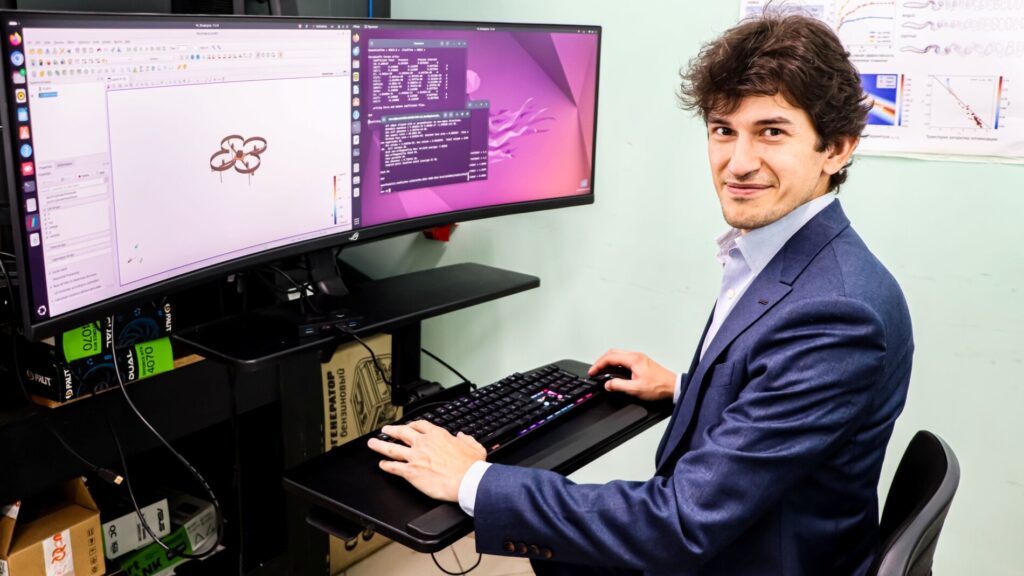
A team led by Artyom Nuriyev, a leading researcher at the Intelligent Biomimetic and Nature-Based Systems Laboratory at the Lobachevsky Institute of Mathematics and Mechanics, have developed a universal mathematical model describing the behavior of an oscillating body in a viscous medium.
The new theory, verified using numerical models and experimental data, allows for the calculation of hydrodynamic forces for any cross-sectional shape of an elongated body using a single formula. The work was supported by a grant from the Russian Science Foundation and published in the Journal of Fluid Mechanics.
According to Nuriyev, oscillatory motion in liquids and gases is all around us. These include sea waves crashing against bridge supports, platforms, and gusts of wind that rock high-rise buildings and bridges, as well as vibrations in the hulls of ships and underwater vehicles. These are the foundations of the swimming and flight of living organisms – from microscopic bacteria to whales and birds. This is why calculating such motions is of great importance both in engineering practice and in fundamental science.
“Previously, this problem was solved using the principle: ‘For every shape, its own model.’ There was one formula for round cylindrical bodies, another for elliptical ones, a third for rectangular airfoils, and a fourth for airfoils. Each of these was derived anew, from scratch, with its own unique mathematics. If an engineer was designing a new shape for an oscillating element, they couldn’t find a ready-made answer from a reference book. They were forced to either conduct expensive full-scale tests or derive a new approximate solution. Our theory, however, offers a universal solution that works for any configuration,” the scientist explained.
It is important to note that the authors derived the new theory strictly mathematically from the fundamental Navier-Stokes equations, which are considered the cornerstone of hydrodynamics and describe the motion of any viscous fluid. To do this, they used the method of asymptotic expansions, based on the assumption of rapid and small oscillations.
The scientists solved the equations in various flow regions: away from the body, where the fluid behaves as an ideal fluid, and in a thin viscous layer near the wall. The final formula included three key components: the added mass force, the Basset force (responsible for the ‘memory’ of the medium), and the viscous friction force.
One interesting aspect of the calculations is the fluid’s ‘memory.’ This effect means that the flow stores information about the fluid’s motion history.
“Roughly speaking, the fluid doesn’t have time to ‘forget’ what happened in previous oscillation cycles. In mathematics, this effect is described by the Basset force. In our work, we derived a universal formula for this force, which allows us to accurately account for the motion history. The primary application of our theory lies in innovative high-tech fields. These include biomimetic robotics, including biosimilars, unmanned aerial vehicles, and underwater vehicles. These include microfluidic devices and microelectronic cooling systems. In such designs, interaction with the environment is crucial. Without accurately calculating transient forces, including the very same ‘memory’ of a fluid, it is impossible to create a functional device. Our formula gives engineers a previously unavailable tool—a tool for accurately accounting for this ‘memory’ for a body of any shape,” explained Nuriev.
The scientists emphasize that their discovery doesn’t eliminate the experimental method, but rather changes its role in the design process. Now, engineers don’t need to guess or build complex setups for each new part at the initial stages. Simply enter the cross-sectional geometry into the derived formula and obtain an analytical expression for the hydrodynamic force. The article already provides ready-made coefficients adapted for specific engineering calculations, making the theory accessible for practical use.
The new theory’s application spans many areas of modern science and technology.
“In robotics, this includes calculating loads on the fins and wings of biomimetic vehicles, including biomimetic UAVs and UUVs. In energy, this includes the design of wave power plants and offshore platforms. In microelectronics, these are cooling systems where vibrating elements stir the liquid. In biomedicine, these are ‘laboratories on a chip,’ where vibrations control cell movement. In atomic force microscopy, this involves calibrating sensors operating in liquid media. In other words, practically anywhere there is oscillatory motion—in liquids or gases,” explained Nuriyev.
In the future, the researchers plan to develop a complete theory of the movement of birds, fish, and similar autonomous vehicles.
“Such a theory must take into account not only the non-stationary forces we’ve already learned to calculate in our current work, but also the mechanisms that generate thrust and the resulting directional motion. This is a significantly more complex task, since thrust in nature is generated by the formation of secondary jet streams that emerge against the backdrop of primary oscillations. This higher-order nonlinear effect remains beyond the scope of our theory,” the interviewee clarified.