

Unique research held at Lake Kronotskoye in Kamchatka
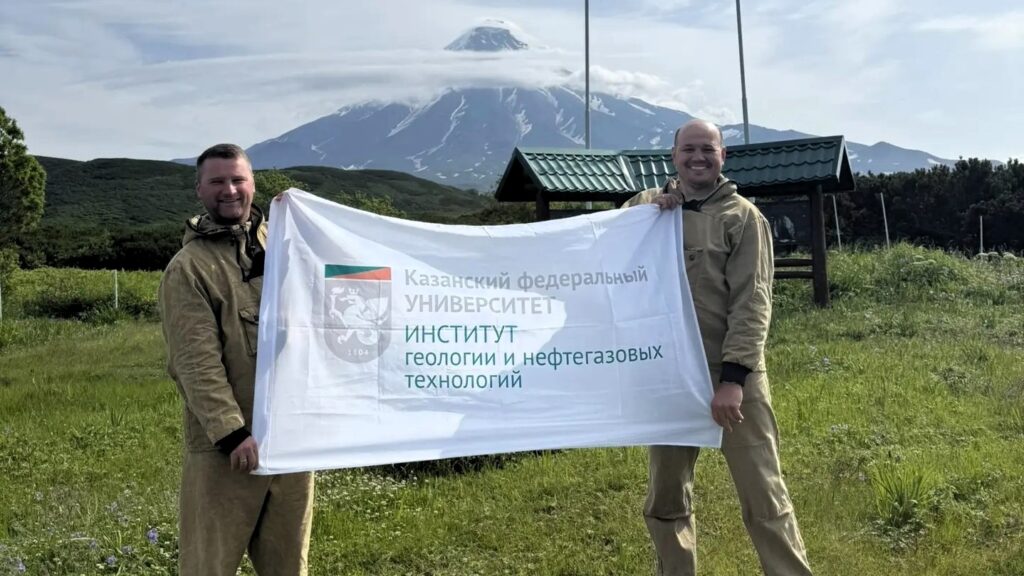
During the first seismoacoustic surveys of Lake Kronotskoye, Kamchatka’s largest freshwater body, geophysicists from the Institute of Geology and Petroleum Technologies obtained unique data on the structure of the lake’s bottom sediments, which contain records of volcanic eruptions spanning tens of thousands of years.
«Airat Dautov, Director of the Institute of Geology and Petroleum Technologies’ Countryside Camps and Expeditionary Work Center, and I went on a joint expedition to Kamchatka with the Institute of Geography of the Russian Academy of Sciences,» explains Pavel Krylov, Deputy Director for Research at IGPT. «Lake Kronotskoye is a poorly studied body of water because it is located in a remote mountain area. We had to reach it by helicopter. Seismoacoustic surveys of the lake’s bottom sediments were conducted. A compact boomer-type electrodynamic emitter developed at Kazan Federal University was used to generate acoustic pulses. We were able to obtain high-resolution seismoacoustic sections that clearly demonstrate the sedimentary structure over 10 meters thick, which will significantly simplify their stratigraphic interpretation. The data we obtained will soon be transferred to the Institute of Geography of the Russian Academy of Sciences. Its employees will be able to determine the most suitable locations for collecting long sediment cores.»
Kronotskoye Lake, with an area of 245 square kilometers and a maximum depth of 148 meters, is located in the eastern part of the Kamchatka Peninsula. It is part of the Kronotsky State Nature Biosphere Reserve and the Volcanoes of Kamchatka UNESCO World Heritage Site.
«The origin of this lake is closely linked to volcanic processes. It formed approximately 10,000-12,000 years ago as a result of the damming of the ancient Paleo-Kronotskaya River by powerful lava and pyroclastic flows during the eruptions of the Kronotsky and Krasheninnikov volcanoes,» added Krylov. «Scientists from the Institute of Volcanology and Seismology of the Far Eastern Branch of the Russian Academy of Sciences believe that the lake’s bottom sediments are a kind of chronicle of catastrophic eruptions over the past 30,000-40,000 years. Tephra horizons — deposits of material ejected by the volcano — were discovered in the lake’s coastal outcrops. These layers are associated with the formation of the Uzon, Geysernaya, and Krasheninnikov calderas. It is these geological ‘archives’ on the lakebed that scientists from the Institute of Geography of the Russian Academy of Sciences plan to study using our high-precision seismoacoustic data and the long cores they have extracted, in order to reconstruct in detail the history of climate and volcanism in Kamchatka.»