

Further cooperation discussed with East China Petroleum University
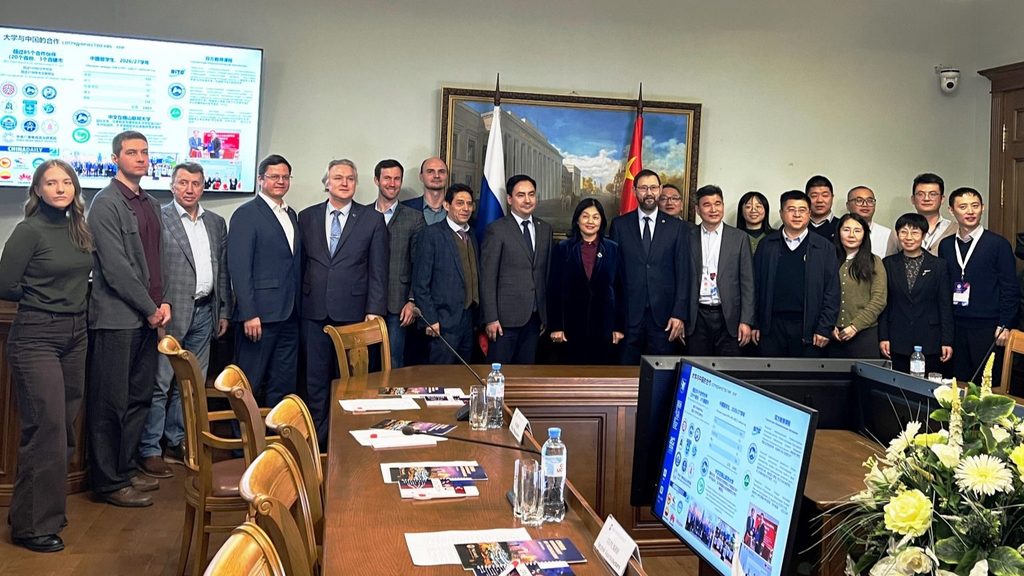
A delegation from China University of Petroleum (East China) met with Kazan Federal University leadership at KFU. The purpose of the meeting was to advance the already fruitful cooperation between the two universities.
The Chinese side was represented by Vice President Dai Caili; Huang Fang, head of the Office of International Cooperation, Hou Yingfei, head of the Academic Affairs Office, and others.
KFU was represented at the working meeting by Timirkhan Alishev, vice rector for international affairs; Danis Nurgaliev, director of the Institute of Geology and Petroleum Technologies (IGPT); Mikhail Varfolomeev, director of the Small-Tonnage Chemical Technology Park; Alexander Lamberov, director of the Catalyst Factory; and Ildus Chukmarov, director of the Center for Continuing Education, Quality Management, and Marketing (CdoGEO).
Welcoming the guests, Alishev noted that China University of Petroleum is a reliable partner of KFU and works successfully with IGPT, the Institute of Philology and Intercultural Communication, and the Law Faculty.
“The cooperation agreement with China University of Petroleum was signed in 2020. Our collaboration is now developing mainly in education, and on several tracks at once: students from this university study geology at IGPT, learn Russian at the Institute of Philology and Intercultural Communication, and study energy law at the Law Faculty,” the vice rector of Kazan University explained afterward.
In her remarks, Dai Caili described her meetings with KFU leadership in both Russia and China and the successful cooperation in personnel training.
“IGPT instructors Boris Platov and Rail Kadyrov came to us to deliver lectures in English. Their classes were very useful for our students. We also were visited by Mikhail Varfolomeev, who helped us,” the vice president of China University of Petroleum said.
She emphasized that it is not only the universities that are cooperating successfully, but also the regions where they are located, the Republic of Tatarstan and Shandong Province.
She also recalled the launch of the China-Russia University of Advanced Technologies (CRUTech). This large-scale network project was kicked off this week at the Forum of Technical Universities of Russia and China. The consortium includes 11 universities from Tatarstan and 14 from Shandong Province.
Alishev explained how cooperation will work within CRUTech and expressed hope that, after the meeting at Kazan Federal University, representatives of the two universities would leave with new ideas and plans for developing their cooperation.
“IGPT is running a dual-degree program with China University of Petroleum,” said Boris Platov, senior lecturer in the department of petroleum geology. “So far, six citizens of China have graduated from it. In addition, two students from this Chinese university completed professional retraining at IGPT’s Center for Continuing Education, Quality Management, and Marketing (CdoGEO). Next year, three students from China are expected to come to us for retraining.”
After the meeting, the guests, accompanied by Varfolomeev, visited the laboratories of the Institute of Geology and Petroleum Technologies, where they were shown scientific installations, instruments, and research.
“A large delegation from China University of Petroleum, led by a vice president, has come to visit us. Representatives of this university are very interested in launching joint projects in various areas, including technology. Both our Chinese colleagues and we have interesting developments. We are aiming for mutually beneficial cooperation,” Varfolomeev told a reporter.
Representatives of China University of Petroleum watched the scientific equipment at IGPT with great interest and asked questions.
“Visiting the laboratories of the Institute of Geology and Petroleum Technologies at Kazan University was not only very interesting but also useful for the development of our cooperation,” said Vice President Dai Caili.
The IGPT director assured guests that scientific and educational cooperation with the Chinese university will expand.
“China University of Petroleum is one of the world’s leading specialized universities, and working with it is very important to us. We are currently running a joint master’s program and also conducting research together. The university’s main campus is in Qingdao, home to some of China’s key state laboratories, which creates a good basis for developing the partnership. In particular, IGPT plans to work with the Chinese university on fundamental topics, such as determining the age of oil,” Nurgaliev said in turn.