

Gazprom Neft, Novosibirsk State University, and KFU to jointly develop hydraulic fracturing innovations
Hydraulic fracturing is the primary technology for increasing hydrocarbon recovery efficiency, used to develop hard-to-recover reserves and mature fields. Planning and executing fracking is a complex engineering task: it is necessary to consider the geological features of the reservoirs, select equipment operating parameters, and select chemical compositions for each specific field.
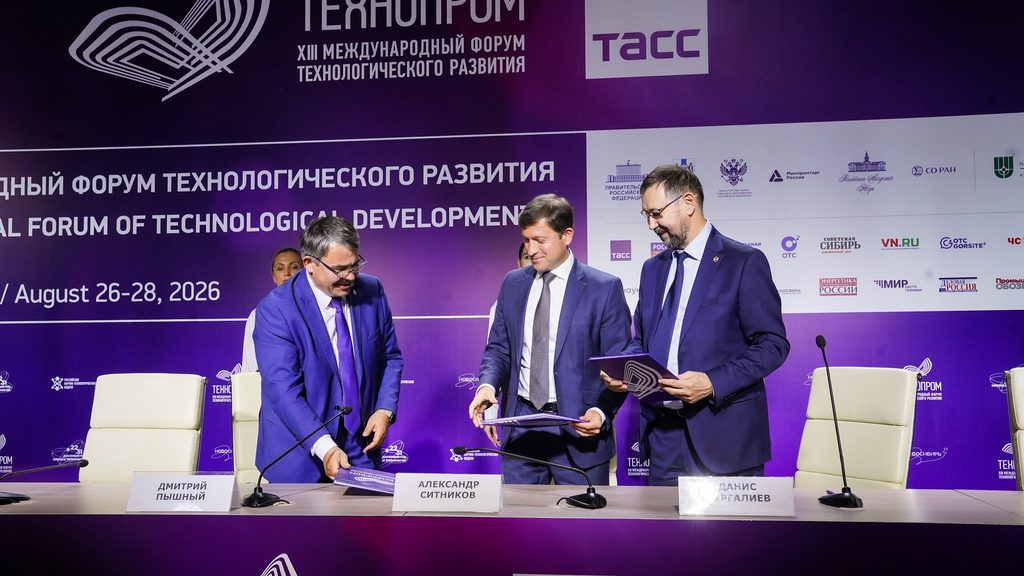
Gazprom Neft, Kazan Federal University, and Novosibirsk State University will develop digital modeling technologies for underground processes and develop and test Russian-made reagents for hydraulic fracturing. The company will provide industrial expertise and testing facilities for new fluid formulations, proppants (used to seal fractures after HF – editor’s note), reagents, and other materials for underground operations. NSU will develop expertise in mathematical and engineering modeling of oil production, while our university will provide a scientific and experimental base for studying chemical processes and creating reagents.
«As complex reserves are developed, oil production is becoming more knowledge-intensive: a single technological solution increasingly requires expertise from several disciplines. Therefore, we are consistently uniting strong scientific schools around specific production challenges. NSU and KFU complement Gazprom Neft’s expertise, and our industrial testing capabilities allow us to more quickly transfer promising ideas from the laboratory to the field,» explained Alexander Sitnikov, Head of the Gazprom Neft Scientific and Technical Center.
Danis Nurgaliev, Vice Rector for Earth Sciences of KFU, emphasized that it is especially important for modern science that research results find practical application.
«Cooperation with Gazprom Neft allows us to combine the university’s scientific competencies with the expertise and demands of the oil production industry. The new agreement creates additional opportunities for the joint development of technologies and materials that can be evaluated not only in the laboratory but also for their application in production,» he concluded.