

KFU partners up with leaders of the petroleum industry for digitalization initiatives
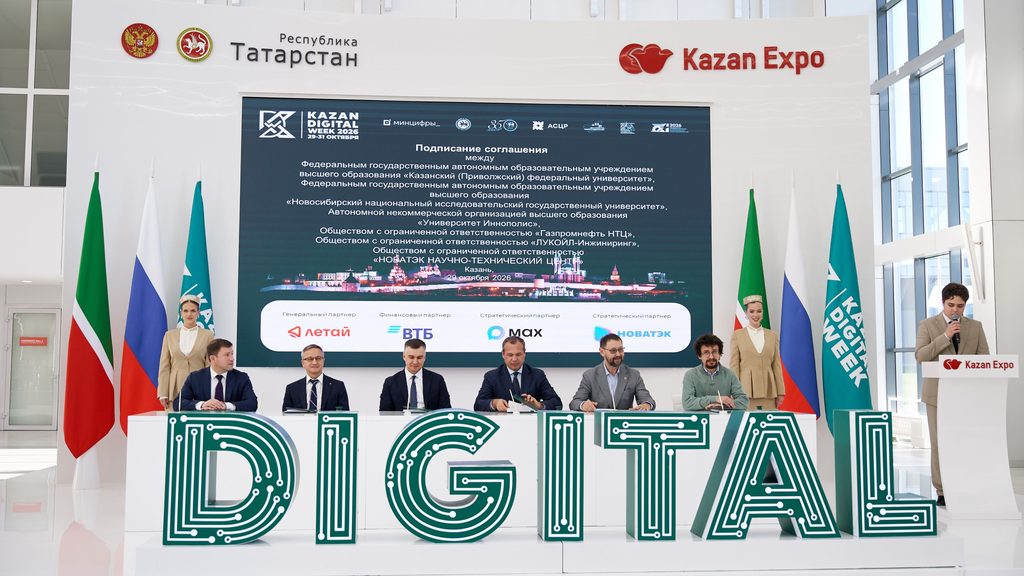
A strategic cooperation agreement was signed at the Kazan Expo International Exhibition Center during the Kazan Digital Week International Forum by the Gazprom Neft Science and Technology Center, Kazan Federal University, Novosibirsk State University, Innopolis University, and LUKOIL-Engineering.
The agreement aims to advance the digitalization of the oil and gas industry. The partners will conduct research and develop software tools for geology, reservoir simulation, drilling, production, and laboratory studies. The founders of this cross-sector alliance expect it to help address engineering challenges and foster innovation in Russia’s fuel and energy sector.
Alexander Sitnikov, Head of the Gazprom Neft Science and Technology Center, commented on the challenges underlying the agreement, «Today, Russia’s fuel and energy sector faces major challenges associated with the increasing complexity of its resource base and the growing share of hard-to-recover hydrocarbon reserves. This is a global challenge that can only be addressed through cross-sector collaboration, bringing together the knowledge, scientific capabilities, and resources of universities and industry. The new agreement will help us not only objectively assess priority tasks but also identify ways to advance engineering and strengthen the technological independence of the oil and gas industry.»
Danis Nurgaliev, Director of the Institute of Geology and Petroleum Technologies, also commented on the significance of the agreement.
“The signing of an agreement on long-term cooperation and partnership in applying artificial intelligence technologies across various segments of the oil and gas industry — from prospecting, exploration, and production to the creation of digital core models and the digitalization of laboratory studies — is a pioneering development. It will mark the beginning of the work of a consortium that currently brings together a small number of participants. We expect our consortium to expand significantly over the coming year. The use of artificial intelligence tools is currently the most promising avenue across all areas of human activity. Applying AI in the oil and gas sector opens up fundamentally new opportunities to improve the efficiency and environmental performance of oil and gas production. Establishing a consortium that brings together universities and leading industrial and research organizations is an important step along this path,” he emphasized.
The industrial partners will contribute their expertise and existing work in production digitalization, define industry needs for digital technologies, and support the development, testing, and implementation of new engineering products. The universities will contribute their research capabilities, offer solutions to specific business challenges, and help develop programs to train a new generation of professionals.