

Negotiations held with Shandong University of Science and Technology
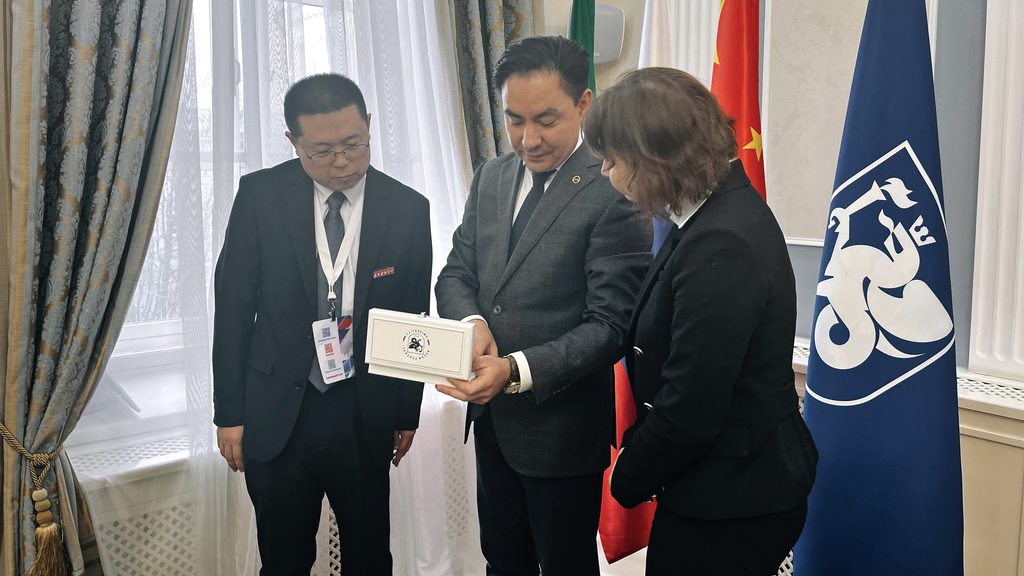
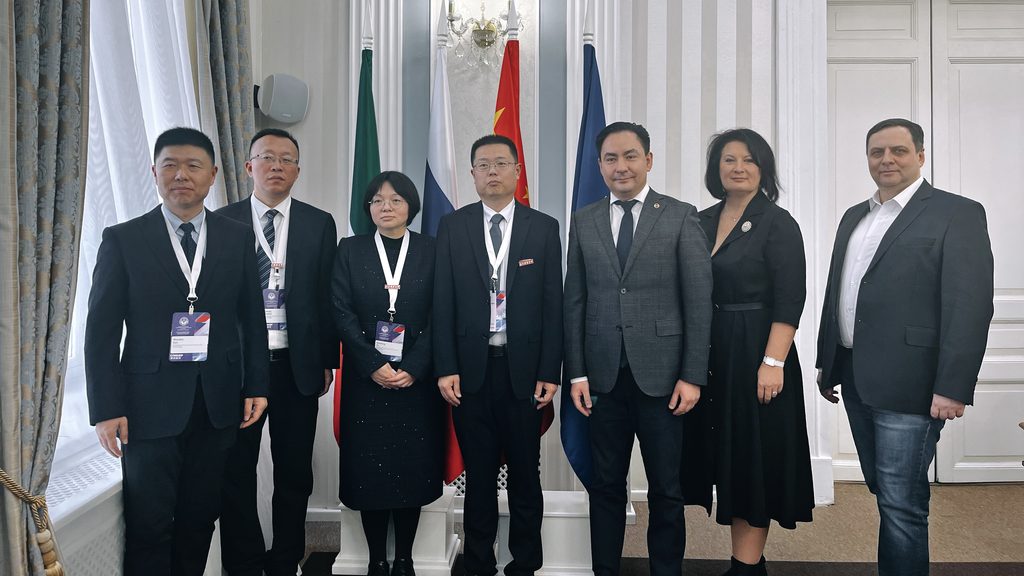
During the Forum of the Association of Technical Universities of Russia and China (ATURC), a delegation from Shandong University of Science and Technology visited Kazan Federal University on November 24. The delegation included Zhu Jingyi, vice president of the Chinese university; Yu Wenfang, head of the Office of International Cooperation and Exchange; Sun Wenbin, director of the Institute of Energy and Mining Engineering; and Zhang Qiang, head of the Institute of Mechanical and Electrical Engineering.
KFU was represented at the meeting by Timirkhan Alishev, vice rector for international affairs; Olga Vershinina, director of the International Office; Irina Maksimova, deputy director of the Institute of Information Technologies and Intelligent Systems (ITIS); and Evgeny Magid, head of the Department of Intelligent Robotics at ITIS.
Opening the meeting, Alishev thanked the guests for the warm welcome extended to the Kazan University delegation during its recent visit to Shandong. He noted that the two sides now face the task of carrying out the memorandum and agreement they signed in science and education.
“I hope that today we will define the prospects for our cooperation,” the vice rector said.
Alishev gave a brief overview of Kazan Federal University’s history, infrastructure, and international activities. He emphasized that the university has more than 85 partners and works with nearly all of China’s leading universities. He also reminded the guests that KFU hosts the second-oldest Confucius Institute in Russia, which opened in 2007. Speaking about summer schools, the vice rector said that this year 10 students from Shandong Province took part in the university’s Summer University, and he expressed hope that the program will expand.
“Next year, we will definitely invite students from your university. We cover all costs related to airfare, housing, and meals for the selected third- and fourth-year undergraduate students,” he said.
Zhu Jingyi, vice president of Shandong University of Science and Technology, thanked the hosts for the detailed presentation and said that this was the second time that visiting Kazan University had given a sense of warmth and home. Zhu emphasized that KFU, as one of Russia’s oldest universities with a rich history, commands even greater respect, and that it is the flagship university within the CRUTech project, which makes today’s meeting especially important.
Zhu also pointed to the close alignment between the two universities’ research areas.
“The Institute of Geology and Petroleum Technologies, together with our Institute of Petroleum and Chemical Technology, fit together very well, as do artificial intelligence and robotics,” Zhu said.
The Chinese vice president added that time, like the sea, is made up of small and large drops, and that through small steps the two sides can build large-scale projects. Zhu said that colleagues at the Chinese university are strongly committed to working together.
Irina Maksimova presented the institute’s areas of focus: software engineering; software development using artificial intelligence, virtual reality, and augmented reality technologies; and intelligent robotics. She said that in January 2026, Zhou Jiehan, a professor at the School of Computer Science and Engineering at Shandong University of Science and Technology, proposed signing a science and education cooperation agreement.
Evgeny Magid said that over 20 years of working abroad he has built an extensive network of collaborations with China, India, Israel, Japan, the United Kingdom, and the United States. Projects with Israel, India, Thailand, and Japan have already been successfully completed. Since 2017, the department has been actively engaged in medical robotics and has been submitting grant applications to the Russian Science Foundation (RSF) jointly with Professor Li Hongbin of Shanghai Jiao Tong University.
“When a professor from Shandong University contacted me in January 2026, I was delighted at the opportunity to expand our collaborations,” Magid explained.
According to Magid, the parties are discussing joint publications, student exchanges, and research visits, and they are currently seeking funding. He also noted that he serves as director of the master’s program in intelligent robotics.
“Last year, one student from China enrolled with us, and this year another one did. We would be glad to see even more students from China enroll. They are very hardworking and good students,” he said.
The department head expressed confidence that exchanges of undergraduate and graduate students, who would then return to Shandong University, would strengthen ties in robotics.
At the end of the meeting, Zhu Jingyi invited KFU representatives to make a short-term visit, saying the Chinese university would be glad to host them at the institute. Timirkhan Alishev, in turn, invited the guests to visit the Summer University in 2027.
“This is a good start, and from here, we proceed step by step,” he said confidently.